
Pricing Psychology for Sugar Land Home Sellers
The Psychology Behind Pricing Homes Correctly in Sugar Land
About the Author: Sharon Yeary is a licensed Texas Broker, Broker/Owner of Sharcom Realty, and a HAR Platinum Real Estate Agent with more than 26 years of experience serving buyers and sellers across Katy, Houston, Fulshear, and Dallas-Fort Worth. She is a certified instructor at Champions School of Real Estate, a Contract Instructor and Facilitator with the Texas Association of REALTORS, and an AI-certified real estate professional. Phone: 832-388-9945 | SharcomRealty.com
Table of Contents
Price Is Not Just a Number — It Is a Message
Quick Answer: What Is the Psychology Behind Pricing a Home Correctly?
Why Pricing Psychology Matters More in Sugar Land Than Sellers Expect
How Buyers Actually Process Price
The Anchoring Effect and Why the First Number Matters Most
What Overpricing Really Costs Sugar Land Sellers
Precision Pricing: How AI and Broker Experience Find the Right Number
Key Takeaways
FAQ
Work With Sharon
Price Is Not Just a Number — It Is a Message
Most sellers think about pricing as math. You look at what similar homes sold for, you pick a number that feels fair, and you wait to see what happens. If that approach worked reliably, there would be no such thing as a price reduction, and expired listings would not exist.
Pricing a home is not just math. It is communication. The number you put on your home sends a signal to every buyer, every buyer's agent, and every competing listing in your market. That signal shapes first impressions before anyone walks through the door, before anyone reads the description, and before your listing photos even finish loading. A well-chosen price invites serious buyers and creates urgency. A poorly chosen price — even if only slightly off — triggers skepticism that is very difficult to recover from.
I am Sharon Yeary, Texas Broker and Broker/Owner of Sharcom Realty. I have priced and sold homes in the Houston metro area, including Sugar Land, for more than 26 years. What I have seen consistently is that the sellers who understand how buyers think about price make better decisions, sell faster, and net more money. This post breaks down the psychology so you can price with intention instead of guessing.
Quick Answer: What Is the Psychology Behind Pricing a Home Correctly?
Here is the short version:
Buyers do not evaluate price in isolation. They compare your home to everything else active in the market, and their perception of value is shaped by that comparison
The first number sets an anchor in the buyer's mind. Changing it later rarely restores the original impression
Overpricing does not give you room to negotiate. In most cases, it eliminates the buyers who would have paid the most
Strategic precision pricing, using specific numbers rather than round figures, can increase perceived value and generate stronger buyer engagement
Days on market is a public signal. Accumulating it sends a message to buyers that something is wrong, even when nothing is
AI-powered pricing analysis identifies the optimal number by combining real market data with buyer behavior patterns that manual analysis misses
Why Pricing Psychology Matters More in Sugar Land Than Sellers Expect
Sugar Land is a well-established market with strong community appeal, highly rated Fort Bend ISD schools, and a mix of master-planned neighborhoods and custom-home communities. Buyers shopping in Sugar Land are typically informed, often already familiar with the area, and frequently comparing multiple homes within a focused price range.
That context matters for pricing because it means your competition is real and visible. A buyer considering your home in First Colony or Riverstone has likely already toured two or three comparable properties in the same neighborhood. They arrive with a mental benchmark. If your price signals that you do not understand your own market, or that you are testing what the market will bear, experienced buyers notice immediately and move on.
Sugar Land also draws relocation buyers from outside Texas, many of whom are moving from markets where prices are significantly higher. Those buyers can be initially receptive to Sugar Land's relative value, but they still rely on their local buyer's agent to interpret whether a specific listing is priced fairly. A price that does not align with what the data supports will be flagged by that agent before the buyer ever schedules a showing.
How Buyers Actually Process Price
Price Is the First Filter, Not the Final Decision
When a buyer or their agent enters search criteria into the MLS, price is the first parameter they set. Your listing will never appear in front of a buyer whose search ends at $500,000 if your home is listed at $510,000. Those buyers, the ones most likely to value your home at its actual worth, never know it exists.
This is one of the most common and costly pricing mistakes sellers make. They price slightly above the natural search bracket to leave room to negotiate, and in doing so they remove themselves from the consideration set of the most qualified buyers in that range entirely. The negotiating room they built in ends up being irrelevant because the right buyers never saw the listing.
Perceived Value Is Relative, Not Absolute
Buyers do not experience your home's price as a standalone number. They experience it relative to the other homes they have seen and the prices attached to them. If three comparable homes in your neighborhood are listed between $480,000 and $495,000 and yours is at $525,000, buyers do not think your home might be worth $525,000. They think it is overpriced by $30,000 and wait to see if you will reduce.
This is why understanding active competition is as important as analyzing past sales. A price that would have been competitive three months ago may be positioned poorly against what is on the market today. Pricing is not a one-time calculation based on historical data. It is a strategic decision based on what buyers are seeing right now.
The First Weekend Tells You Everything
In an active market like Sugar Land, the first seven to ten days of a listing are the highest-traffic period your home will ever see. The buyers who have been waiting for the right home, who have their financing in order and are ready to act, are the ones who respond immediately to new listings. If your price is right, this group converts to showings, offers, and often a contract within the first two weeks. If your price is wrong, they see the listing, dismiss it, and move on. That first wave of motivated buyers does not come back for the price reduction.
The Anchoring Effect and Why the First Number Matters Most
What Anchoring Means in Real Estate
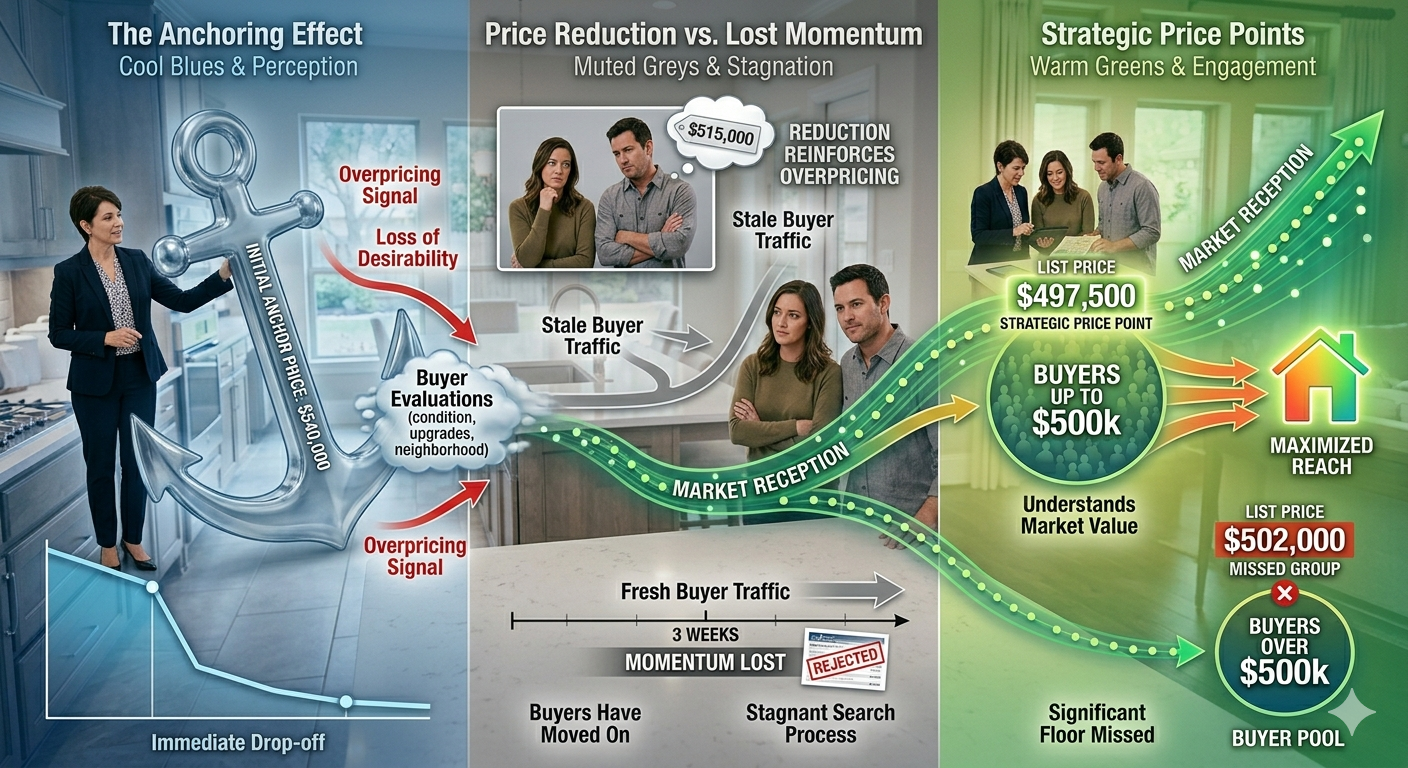
Anchoring is a cognitive bias where the first piece of information a person receives establishes a reference point that influences every subsequent evaluation. In real estate, your list price is the anchor. Everything buyers learn about your home afterward — the condition, the upgrades, the neighborhood amenities — gets processed in relation to that initial number.
If you list at $540,000 and reduce to $515,000 three weeks later, most buyers do not experience the reduced price as a fresh opportunity. They experience it as confirmation that something was wrong with the listing. The original anchor created a perception of overpricing, and the reduction reinforces it rather than erasing it.
Why Price Reductions Rarely Recover Lost Momentum
Sellers often believe that a price reduction will reset buyer interest and bring in a fresh wave of traffic. In practice, the effect is more limited. The buyers who dismissed the listing when it was overpriced are typically well past it in their search process. They may have made offers on other homes or adjusted their criteria. The buyers who see the reduced listing are often those who were priced out at the original number and now see the home as available, but no longer particularly desirable.
The reduction signals that the market rejected the original price, and buyers absorb that signal even when they are not consciously aware of it. The single most effective thing a seller can do is get the price right before the listing goes live.
Strategic Price Points Change Buyer Behavior
Sellers sometimes dismiss the psychological impact of specific price points as trivial. It is not. A home listed at $497,500 reaches every buyer searching up to $500,000 and positions the seller as someone who understands market value. A home listed at $502,000 misses every buyer with a $500,000 ceiling, a group that represents a significant portion of the qualified buyer pool in that range. These are not minor rounding differences. They are meaningful strategic choices that affect who sees your home.
What Overpricing Really Costs Sugar Land Sellers
Overpricing Eliminates the Best Buyers First
The buyers most likely to pay close to or at your asking price are the ones whose search includes your listing from day one. Those are buyers with budgets aligned with your price, which means they have seen the comparable properties in that range and are capable of making an informed offer. Pricing above that range removes you from their search entirely and replaces them with buyers whose true budget ceiling is higher than yours, buyers who are evaluating your home as a compromise, not a target.
Days on Market Becomes the Story
Every day a home sits on the market in Sugar Land, the story buyers tell themselves about it gets worse. At day fourteen, buyers wonder why it has not sold. At day thirty, they begin asking what is wrong with it. At day forty-five, the offers that come in begin to reflect the stigma attached to extended days on market, not the home's actual value. By that point, many sellers end up netting less than they would have if the home had been priced correctly at launch.
The Carrying Cost Equation
Sellers sometimes think of an overpriced period as a free trial: if no offers come in, they will simply reduce. What they underestimate is the real cost of that waiting period. Mortgage payments, property taxes, insurance, HOA fees, and ongoing maintenance expenses accumulate every week the home is on the market. In a market like Sugar Land, where correctly priced homes can sell within weeks, a two-month overpricing period before a reduction is not a neutral experiment. It is a measurable financial loss.

Precision Pricing: How AI and Broker Experience Find the Right Number
Why a CMA Is a Starting Point, Not an Answer
A comparative market analysis gives you a range of recent sale prices for similar properties. It does not tell you where within that range your specific home should land, or how the current active competition positions your listing in the market today. Translating comparable data into a defensible and strategic price requires judgment, and that judgment is informed by how buyers are behaving right now in your specific neighborhood and price tier.
AI-Powered Pricing Adds a Layer Standard Analysis Cannot Replicate
AI pricing tools analyze buyer behavior patterns, absorption rates, days-on-market trends, and price trajectory data across the Sugar Land and Fort Bend County market. They can identify where demand is concentrated, which price points are attracting the most qualified buyer activity, and how similar listings have performed under current conditions. Combined with broker experience in the specific submarket, this data produces a price recommendation that is not a guess or a formula. It is a strategic position built on real evidence.
The Right Price Generates the Right Outcome
In most cases, a well-priced Sugar Land home does not need to sit and wait. It enters the market with momentum, attracts a concentrated wave of serious buyers during the first weeks, and either sells quickly or produces leverage for a strong negotiation. That is not lucky timing. It is the result of pricing with precision, understanding what buyers see when they look at your listing, and positioning the home to win in the market as it actually exists, not as the seller wishes it did.
Key Takeaways
Pricing is not math alone. It is the first and most powerful message your home sends to the market
The anchoring effect means your list price shapes buyer perception in ways that a later reduction cannot fully undo
Overpricing eliminates the most qualified buyers first by placing your home outside their search range
Days on market accumulate fast in Sugar Land and create a stigma that directly reduces net proceeds
AI-powered pricing analysis combined with experienced broker judgment identifies the right number before your home goes live, when it matters most
Internal Link Suggestions
Read about why your home isn't selling and what you can do about it
Discover common seller mistakes that cost Texas homeowners money
Schedule a private AI-powered seller or buyer strategy consultation
FAQ Section
Q: How do I know if my home is priced correctly in Sugar Land? A well-priced home in Sugar Land should generate showings within the first week and receive offers within the first two to three weeks in a normal market. If your home has been active for more than three weeks without serious offer activity, the price is likely the issue. A broker who understands the current Sugar Land market and uses AI-powered pricing tools can evaluate your position against active competition and help you make a data-informed adjustment before the listing loses momentum.
Q: Is it better to price high and leave room to negotiate in Sugar Land? In most cases, no. Pricing above the natural search bracket removes your home from the consideration of buyers whose budgets align with your home's actual value. Those buyers are typically the ones most likely to pay a strong price. The buyers who do see an overpriced listing interpret the gap as a signal that the seller is out of touch with the market, which often results in lower offers or no offers at all. Strategic precision pricing generates more buyer engagement and stronger results than padding for negotiation room.
Q: What is anchoring and how does it affect my home sale? Anchoring is a well-documented cognitive bias where the first number a buyer sees becomes the reference point for all subsequent evaluations. In real estate, your list price is that anchor. If you price too high and reduce later, buyers experience the reduction as confirmation of overpricing, not as a fresh opportunity. The original anchor damages perception in ways that are difficult to recover from, which is why getting the price right at launch is more valuable than any negotiating cushion you think you are building in.
Q: How does overpricing affect how long my Sugar Land home stays on the market? Overpriced homes accumulate days on market quickly because the buyers most likely to act do not see the listing at all, and those who do often dismiss it immediately. As days on market grow, buyer skepticism increases regardless of the home's actual condition. By the time a seller reduces to a competitive price, the stigma of extended market time often means the final sale price is lower than it would have been with accurate pricing from the start.
Q: What makes Sugar Land home pricing different from other Texas markets? Sugar Land buyers tend to be well-informed and often have existing familiarity with the market through Fort Bend County's established neighborhoods. They are frequently comparing your home directly against others in the same community, which makes relative positioning more important than in markets with more dispersed inventory. The Fort Bend ISD school district and the quality of master-planned communities like First Colony and Riverstone add layers of value that a strong pricing analysis accounts for at the subdivision level, not just the zip code level.
Q: How does Sharon Yeary use AI to help with pricing in Sugar Land? AI-powered pricing tools analyze real-time buyer behavior data, absorption rates, days-on-market patterns, and comparable price trajectories across the Sugar Land and Fort Bend County market. Combined with 26 years of experience selling homes in this area, this analysis produces a strategic price recommendation that reflects where qualified buyers are actually concentrating their activity, not just what similar homes sold for in the past. The result is a list price designed to perform from day one, not to be adjusted after the market responds.
"Your list price is not a starting point for negotiation. It is the first thing every buyer decides about your home — before they ever walk through the door." — Sharon Yeary, Texas Broker | Sharcom Realty | 832-388-9945 | SharcomRealty.com

The Right Price Is Not a Guess — Let's Build It From the Data Up
Pricing your Sugar Land home correctly from day one is the single highest-leverage decision you will make in the entire sale. Let's use AI-powered market analysis and 26 years of local experience to find the number that attracts the right buyers, generates real competition, and protects your net proceeds from the moment your home hits the market.
Ask about my AI-powered home search and pricing strategy to help you make smarter moves faster.