
How AI Is Changing Real Estate for Texas Sellers
How AI Is Changing Real Estate for Texas Sellers: What You Need to Know Now
Artificial intelligence is not a future concept in real estate. It is already here, already being used, and already separating sellers who are getting results from sellers who are still relying on strategies that were built for a different market.
The question most Texas home sellers are not asking, but absolutely should be, is not whether AI matters in real estate. It is whether the broker they hired actually knows how to use it.
I am Sharon Yeary, Texas Broker, Broker/Owner of Sharcom Realty, and an AI-certified real estate professional. I have spent more than 26 years in this industry, and I have watched technology reshape it at every stage. Nothing has changed the game quite the way AI has in the past few years. Not home search portals. Not social media marketing. Not virtual tours. AI is operating at a different level entirely, and the sellers who understand that are making smarter decisions faster than the ones who are still waiting to see how it plays out.
This blog breaks down what AI is actually doing in real estate right now, what it means specifically for Texas home sellers, and why experience combined with AI produces something that neither one delivers on its own.
Quick Answer Box: How Is AI Changing Real Estate for Texas Sellers?
AI is transforming the Texas real estate experience for sellers in these key ways:
AI-powered pricing tools analyze real-time market data to sharpen list price accuracy
AI-driven marketing platforms target qualified buyers more precisely than traditional digital advertising
AI can analyze listing performance and identify strategy adjustments faster than manual review
AI-assisted buyer search tools help buyers find homes that match their needs more efficiently, which benefits sellers with well-matched listings
AI can evaluate comparable sales patterns, market absorption rates, and pricing trends simultaneously
Brokers who combine AI tools with deep market experience can move faster, price sharper, and market smarter than those relying on intuition and MLS data alone
Why This Matters for Texas Home Sellers Right Now
Texas is one of the most competitive and diverse real estate markets in the country. From the high-demand suburban communities of Katy and Fulshear to the urban corridors of Houston and the expanding DFW metroplex, sellers across this state are competing in markets where buyer behavior, inventory levels, and pricing dynamics shift quickly.
That pace of change is exactly where AI provides the most value. A market analysis that would have taken a broker hours to compile manually can now be completed in minutes with greater accuracy and more data points than traditional methods could account for. Pricing decisions that once relied heavily on gut feel and a handful of comparable sales can now be informed by pattern recognition across hundreds of data inputs simultaneously.
For Texas sellers specifically, this matters because pricing mistakes and marketing gaps are expensive. Days on market accumulate quickly in a competitive environment, and every week a home sits without an offer is a week of carrying costs, market stigma, and negotiating leverage lost. AI does not eliminate those risks entirely. But in the hands of a broker who knows how to use it, it significantly reduces them.
What AI Actually Does in Real Estate (And What It Does Not)
Let's be clear about something, because there is a lot of noise around AI right now, and not all of it is accurate.
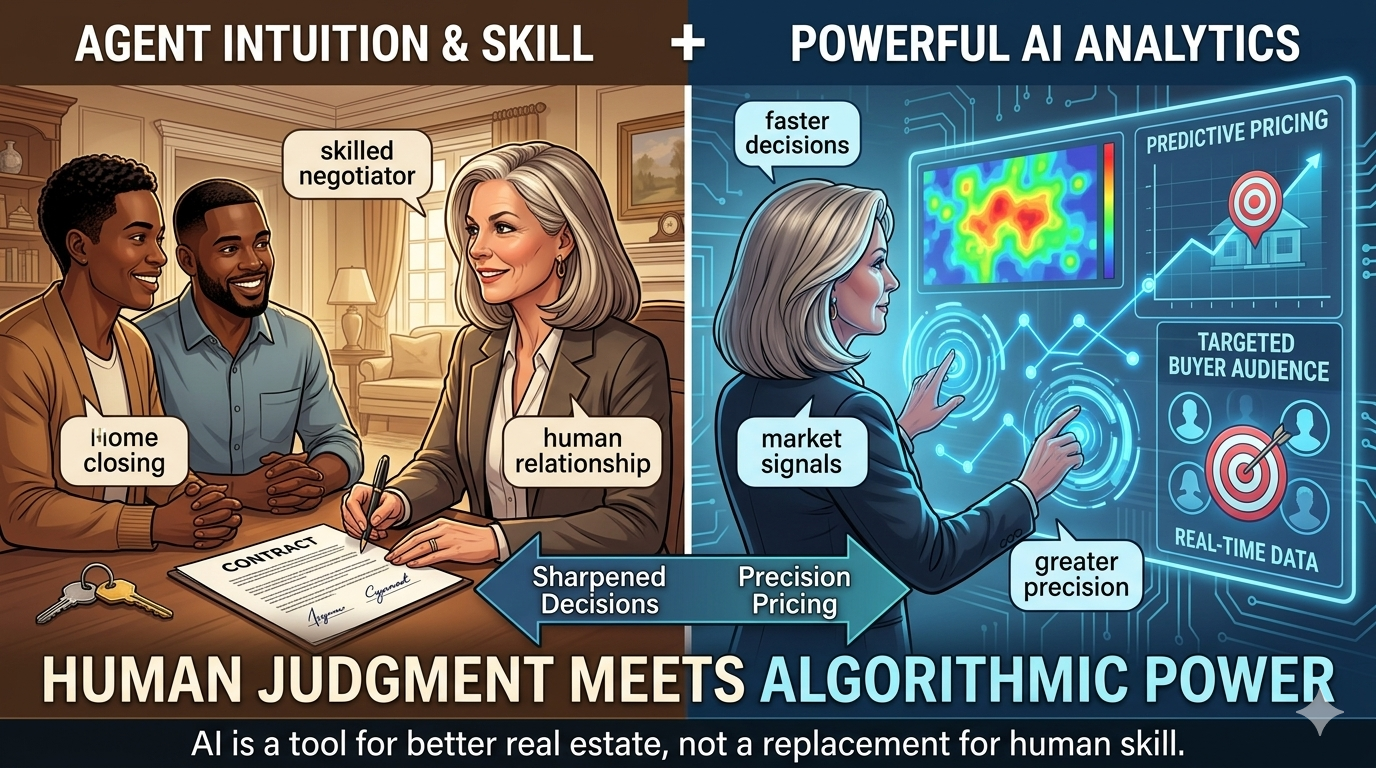
AI does not sell your home. It does not replace the judgment of an experienced broker, the skill of a skilled negotiator, or the relationship-driven nature of a real estate transaction. A buyer who falls in love with your home during a showing is responding to something deeply human. No algorithm closes that moment.
What AI does is sharpen everything around that moment. It helps identify the right price before the listing goes live. It helps reach the right buyers before the showing is ever scheduled. It helps analyze what the market is signaling before a broker might otherwise catch it manually. And it helps a broker make faster, better-informed decisions at every stage of the transaction.
Think of it this way. Experience tells me what to look for. AI helps me find it faster, see more of it at once, and act on it with greater precision. That combination is the real advantage. Not AI alone. Not experience alone. Both, working together.
AI-Powered Pricing: Sharper Data, Better Decisions
Pricing is where AI has made one of its most meaningful contributions to real estate. Traditional comparative market analysis looks at a limited set of recent sales in a defined area and draws conclusions from that data set. It is a useful tool, and an experienced broker interprets it well. But it has real limitations in fast-moving or thinly traded markets.
AI-powered pricing tools pull from significantly broader data sets, including pending sales, listing price histories, days on market patterns, price reduction frequencies, absorption rates by price band, and buyer demand signals that are not visible in a standard MLS search. The result is a pricing picture that is more current, more complete, and more sensitive to micro-market conditions than traditional methods alone can produce.
For Texas sellers, this is particularly valuable in markets where new construction is an active competitor, where inventory shifts quickly, or where pricing in one section of a community can differ meaningfully from pricing just a few streets away. AI does not guess at those nuances. It measures them.
The goal is not to impress a seller with a high number at the listing appointment. The goal is to find the number that generates buyer interest, supports appraisal, and gets the seller to the closing table with the strongest possible net proceeds. AI makes that number more defensible and more accurate from day one.

AI-Powered Marketing: Reaching the Right Buyers, Not Just Any Buyers
Traditional real estate marketing puts a listing in front of as many people as possible and hopes the right buyer is somewhere in that crowd. AI-powered marketing works differently. It identifies who the right buyers are likely to be and puts the listing directly in front of them.
By analyzing data on buyer search behavior, location preferences, price range activity, commute patterns, school district priorities, and lifestyle signals, AI-driven platforms can target digital marketing with a level of precision that broad-based advertising simply cannot match. Your listing reaches buyers who are actively looking in your price range, in your area, and who have shown behavioral signals consistent with making a purchase.
For Texas sellers, this matters most in three scenarios. First, when competing against a high volume of similar inventory and needing your listing to stand out in a specific buyer's feed. Second, when selling a home at a price point where the buyer pool is smaller and every qualified lead counts. And third, when selling a property with unique features or a lifestyle appeal that benefits from reaching buyers who specifically value those attributes.
Casting a wide net is a passive strategy. Targeted marketing is an active one. AI makes targeted marketing available at a level of sophistication that was simply not accessible to individual sellers and boutique brokerages a few years ago.
AI and Listing Performance: Catching Problems Before They Compound
One of the less discussed but highly practical applications of AI in real estate is listing performance analysis. How a listing is performing in its first two to three weeks on the market sends critical signals about whether the pricing, the marketing, or the presentation needs adjustment.
AI tools can track and interpret those signals faster than manual review. Click-through rates on digital ads, save and share activity on listing portals, showing request conversion from online views, and comparative performance against similar active listings can all be monitored and evaluated in near real time.
When the data says something is not working, a broker who is paying attention can adjust the strategy before the listing loses too much momentum. When the data says the listing is performing well and buyer interest is strong, that is also useful information for negotiation positioning when offers come in.
Data without action is just noise. But data combined with an experienced broker who knows what to do with it is one of the most powerful tools available to a Texas home seller in today's market.

The AI-Certified Broker Difference
Not every broker who mentions AI is using it. And not every broker using AI tools is using them well.
The difference between a broker who has completed AI real estate certification and one who has simply heard the terminology is meaningful. AI certification involves understanding how these tools function, what their limitations are, how to interpret the outputs they produce, and how to integrate them into a transaction strategy in a way that actually benefits the client.
I pursued AI certification because I believe sellers deserve a broker who is not just current with the market but current with the tools that are reshaping how that market works. My technology background, which includes more than four decades of experience in technical analysis and systems work long before real estate, gives me a foundation for understanding these tools at a level that goes beyond the surface.
Experience tells me what matters. AI helps me move faster, market smarter, and price with sharper insight. That is not a marketing phrase. It is the practical description of how I work with every seller I represent.
Internal Link Suggestions
Learn about luxury home marketing in Houston and Katy
Read about common seller mistakes that cost Texas homeowners money
Schedule a private AI-powered seller or buyer strategy consultation
People Also Ask
How is AI used in real estate for home sellers?
Can AI help sell my house faster in Texas?
What is an AI-certified real estate broker?
How does AI improve home pricing accuracy?
Is AI replacing real estate agents in Texas?
What is AI-powered buyer targeting in real estate?
How do I find an AI-certified real estate broker in Houston or Katy?
Frequently Asked Questions
Q: Is AI actually being used in Texas real estate right now, or is it mostly hype? AI is actively being used in Texas real estate today, in pricing analysis, digital marketing targeting, listing performance monitoring, buyer search tools, and lead generation systems. The hype is around AI doing everything automatically. The reality is that AI, combined with experienced broker judgment, is producing meaningful advantages in pricing accuracy and buyer reach for sellers who work with brokers who have adopted these tools thoughtfully.
Q: Will AI replace real estate brokers in Texas? No. Real estate transactions involve negotiation, legal contracts, emotional decision-making, and relationship dynamics that AI cannot replicate. What AI does is make brokers who use it more effective, more precise, and more responsive to market data. The brokers most at risk are not those working alongside AI. They are those ignoring it entirely.
Q: What does AI-powered pricing actually mean in practice? It means the pricing recommendation your broker gives you is informed by a significantly broader and more current data set than a traditional comparable sales analysis alone would produce. AI tools can analyze hundreds of data points simultaneously, including active listing patterns, buyer demand signals, price reduction histories, and absorption rates, to produce a list price that is more precisely calibrated to what today's market will support.
Q: How does AI-powered marketing differ from regular digital advertising? Traditional digital real estate advertising typically targets by geography and general demographics. AI-powered targeting goes further, using behavioral data, search pattern analysis, and predictive modeling to identify buyers who are actively in the market and whose behavior signals match the profile of someone likely to purchase your specific home. The result is a higher percentage of qualified eyes on your listing versus broad reach to unqualified audiences.
Q: Do I need to understand AI to benefit from it as a seller? No. Your broker carries the responsibility of understanding and applying these tools correctly. Your job as a seller is to work with a broker who has done that work and can explain clearly how AI is being used in your specific listing strategy and what it is accomplishing for you.
Q: What is the difference between a broker who mentions AI and one who is actually AI-certified? AI certification involves completing formal training in how artificial intelligence tools function within real estate, how to interpret and apply their outputs, and how to integrate them responsibly into client strategy. A broker who mentions AI as a buzzword without that underlying training is marketing a concept. A broker who has completed certification and has the technical background to support it is applying a real capability.
Q: How do I get started with an AI-powered home selling strategy in Texas? The best starting point is a consultation with Sharon Yeary at Sharcom Realty. That conversation covers your home's current market position, a pricing analysis informed by AI-powered tools, and a marketing strategy built around reaching the buyers most likely to purchase your specific property. It is free, it is specific to your situation, and it gives you a real picture of what selling smarter looks like in today's Texas market.

Ready to Sell Smarter With AI and Experience Behind You?
AI is not the future of Texas real estate. It is the present. And sellers who are working with brokers who know how to use it are already ahead.
Your home deserves a strategy that combines what 26 years of Texas market experience knows and what today's best AI tools can see. Let's build that strategy together.
Ask about my AI-powered home search and pricing strategy to help you make smarter moves faster.