
How to Find the Right Neighborhood in DFW
How to Find the Right Neighborhood When Relocating to Dallas-Fort Worth
About the Author: Sharon Yeary is a licensed Texas Broker, Broker/Owner of Sharcom Realty, and a HAR Platinum Real Estate Agent with more than 26 years of experience serving buyers and sellers across Katy, Houston, Fulshear, and Dallas-Fort Worth. She is a certified instructor at Champions School of Real Estate, a Contract Instructor and Facilitator with the Texas Association of REALTORS, and an AI-certified real estate professional. Phone: 832-388-9945 | SharcomRealty.com
Table of Contents
Relocating to DFW Is a Different Kind of Move
Quick Answer: How to Find the Right DFW Neighborhood
Why DFW Relocations Require a Different Strategy
The Questions That Should Drive Your Neighborhood Search
How DFW Is Actually Laid Out and Why Your Commute Depends on It
North Dallas and Collin County: What Buyers Need to Know
Fort Worth, Tarrant County, and the Mid-Cities: What Buyers Need to Know
How to Evaluate DFW Neighborhoods Before You Commit
Key Takeaways
FAQ
Work With Sharon
Relocating to DFW Is a Different Kind of Move
Most people relocating to Dallas-Fort Worth have the same experience. They search online, find neighborhoods that look promising, watch a few YouTube videos about "the best places to live in DFW," and then show up for a four-day house-hunting trip expecting to figure it out as they go. Some of them get lucky. Most of them end up overwhelmed by how large, how spread out, and how genuinely different each part of the metroplex actually is.
Dallas-Fort Worth is not one city. It is a metropolitan area covering more than 9,000 square miles with dozens of distinct cities, hundreds of neighborhoods, and a property market that varies dramatically in price, style, school district, commute, and community feel depending on where you land. Choosing the wrong area is not a minor inconvenience. It is a daily quality-of-life issue that does not get better over time.
I am Sharon Yeary, Texas Broker and Broker/Owner of Sharcom Realty. I have helped relocating buyers settle into the right communities across the DFW metroplex for more than 26 years. The buyers who make smart decisions in this market are not the ones with the most time to search. They are the ones who start with the right questions and work with a broker who actually knows the difference between a Cedar Hill address and a Southlake address and why it matters enormously.
Quick Answer: How to Find the Right DFW Neighborhood
Here is the short version of how to find the right neighborhood when relocating to Dallas-Fort Worth:
Start with your workplace location and your acceptable commute time, since DFW traffic is real and it shapes everything else
Define your priorities in order: schools, price range, community feel, home style, proximity to amenities, HOA or no HOA
Understand that DFW is divided into two major metro halves with very different cultures, price profiles, and community characteristics
Do not rely on national "best neighborhoods" lists, which are often outdated, generalized, or based on criteria that do not match your actual life
Visit in person before committing, and do it on a weekday morning, not just a weekend afternoon
Work with a broker who knows DFW specifically, not just one who is licensed in Texas

Why DFW Relocations Require a Different Strategy
The Dallas-Fort Worth metroplex is the fourth-largest metropolitan area in the United States and one of the fastest-growing. That growth is real and ongoing, and it means that information from even two or three years ago can be significantly out of date. Neighborhoods that were considered up-and-coming have matured. Price ranges have shifted. New master-planned communities have transformed previously rural land into fully built-out suburban corridors in the span of a few years.
For buyers relocating from out of state or from smaller markets, the sheer scale of DFW is the first challenge. It is genuinely easy to buy a home in an area that looks perfect online and then discover that your commute is forty-five minutes each way, that the school district boundary runs through the middle of your block, or that the neighborhood feel is completely different from what the photos suggested.
The buyers who navigate DFW relocations well do so by leading with priorities, not with addresses. They decide what matters most to them before they fall in love with a specific zip code, and they work with a broker who can match those priorities to actual communities with current, accurate market knowledge.
The Questions That Should Drive Your Neighborhood Search
Where Will You Work and What Is Your Honest Commute Tolerance?
In DFW, your workplace address is the single most important starting point for a neighborhood search. The metroplex has significant traffic corridors, and the distance between where you live and where you work can vary enormously in drive time depending on direction and time of day. If your office is in Las Colinas or Irving, communities along the 635, 183, and 114 corridors reduce commute friction. If you are working in Plano's Legacy West area, Collin County communities to the north and east make more sense. If your work is in downtown Fort Worth, Tarrant County communities offer dramatically better access than anything on the Dallas side. Be honest about how much daily driving you are willing to accept, then build your search from there.
What Do You Need From Schools, Even If You Do Not Have Children?
School district boundaries in DFW affect property values significantly, regardless of whether you have school-age children. Homes in highly rated school districts command a premium at purchase and hold that premium at resale. If schools are a priority for your family, identify the districts you want first, then find communities within those boundaries. If schools are less of a priority, you have more flexibility on location and will typically find better value in areas where school ratings are moderate but improving. Either way, confirm the actual school assignments for any specific address before you make an offer, because district boundaries and attendance zones do not always align with zip codes or neighborhood names.
What Kind of Community Feel Do You Want Day to Day?
DFW has everything from walkable urban neighborhoods with restaurant districts and entertainment corridors to quiet, low-density suburban communities built around greenbelts, trails, and single-family homes. It has master-planned communities with resort-style amenities and HOA governance, and it has older established neighborhoods with no HOA and significantly more flexibility. Knowing which environment you actually want to live in, not just which one looks nice in photos, is foundational to finding the right area. Spend time in the places you are considering. Walk around on a Tuesday evening, not just a Saturday afternoon. The difference is informative.

How DFW Is Actually Laid Out and Why Your Commute Depends on It
The Basic Geography of the Metroplex
Dallas-Fort Worth is anchored by two major urban cores: Dallas to the east and Fort Worth to the west, connected by I-30 and Highway 287. Between and around them sits a broad network of suburban cities that vary significantly in character, price point, and development profile. The northern arc, running from Irving through Las Colinas, Grapevine, Southlake, Keller, and up through Collin County, is generally newer, more suburban, and heavily built out around master-planned development. The southern and eastern parts of the metroplex offer more affordability and in some areas a more established community character.
Why the Dallas-Fort Worth Divide Matters for Buyers
Buyers relocating to DFW frequently underestimate how different the Dallas and Fort Worth sides feel in daily life. Dallas skews more urban, faster-paced, and tends to carry higher property values in the closer-in and northern suburbs. Fort Worth has a distinct identity, a strong cultural core, and a housing market that historically offers more value per square foot than comparable Dallas-side communities. The Mid-Cities, which include communities like Grapevine, Bedford, Euless, Colleyville, and North Richland Hills, sit between the two and offer reasonable access to both, which makes them popular with buyers whose work or family ties pull in both directions.
The Role of DFW Airport in Your Location Decision
DFW International Airport sits in the geographic center of the metroplex, and its proximity matters for buyers who travel frequently for work. Communities along the 121 corridor, including Grapevine, Southlake, Flower Mound, and Irving, offer some of the most convenient airport access in the region. If frequent travel is part of your life, this is a practical factor worth weighing alongside schools and price range when you build your search criteria.
North Dallas and Collin County: What Buyers Need to Know
The Market Profile in Collin County
Collin County, which includes Plano, Frisco, McKinney, Allen, and Prosper among others, has been one of the fastest-growing areas in the country for more than a decade. It offers a concentration of highly rated school districts, newer housing stock, corporate campus employment hubs, and a suburban lifestyle that draws significant relocation demand from across the country. That demand is reflected in pricing. This part of the metroplex tends to carry higher home values, especially in the $400,000 to $700,000 range, and competition in well-regarded neighborhoods is active.
Established Communities Versus New Construction Corridors
Plano and Allen represent more established community profiles with mature trees, older neighborhoods, and a mix of housing ages. Frisco, McKinney, and Prosper have large volumes of new construction, with builders actively developing master-planned communities and offering a range of floor plans and price points. Buyers relocating to Collin County should consider whether they want the character and value of an established neighborhood or the configuration and warranty coverage of new construction, since both are available and the right answer depends on priorities.
What Drives Price Variation Within the Area
Within Collin County, price variation is driven primarily by school district, proximity to employment corridors, lot size, and home age. Buyers who are flexible on which specific city they land in often find meaningful value differences between adjacent communities. A broker who knows this market can help you identify where your budget goes furthest based on what you actually care about, rather than defaulting to the most recognizable name on the map.
Fort Worth, Tarrant County, and the Mid-Cities: What Buyers Need to Know
The Fort Worth Market Offers Real Value
Fort Worth consistently offers more home per dollar than comparable communities on the Dallas side, and it has a well-developed cultural identity of its own. The Sundance Square area, the Cultural District, the Near Southside, and surrounding communities have invested significantly in urban revitalization. For buyers who want proximity to a vibrant downtown, access to arts, dining, and entertainment, and a lower price per square foot than you would pay in North Dallas, Fort Worth deserves serious consideration.
Tarrant County Suburban Communities
Keller, Colleyville, Southlake, and Westlake sit in the upper tier of the Tarrant County suburban market, with strong school districts, high owner-occupancy rates, and well-maintained housing stock. Hurst, Euless, and Bedford, collectively known as HEB, offer a centrally located alternative with strong community infrastructure and more accessible price points. North Richland Hills and Watauga provide additional options for buyers whose budgets are better served by value-oriented communities that still offer good suburban amenities.
The Mid-Cities as a Strategic Middle Ground
The Mid-Cities corridor, running roughly from Grapevine and Irving through Bedford and Euless to Arlington, sits at the geographic and practical center of the metroplex. Buyers who need reasonable access to both Dallas and Fort Worth, or who work near DFW Airport, frequently find that this area delivers the best overall balance of location, price, and commute flexibility. It is an underappreciated part of the metroplex for buyers who do their research rather than defaulting to the most talked-about communities.
How to Evaluate DFW Neighborhoods Before You Commit
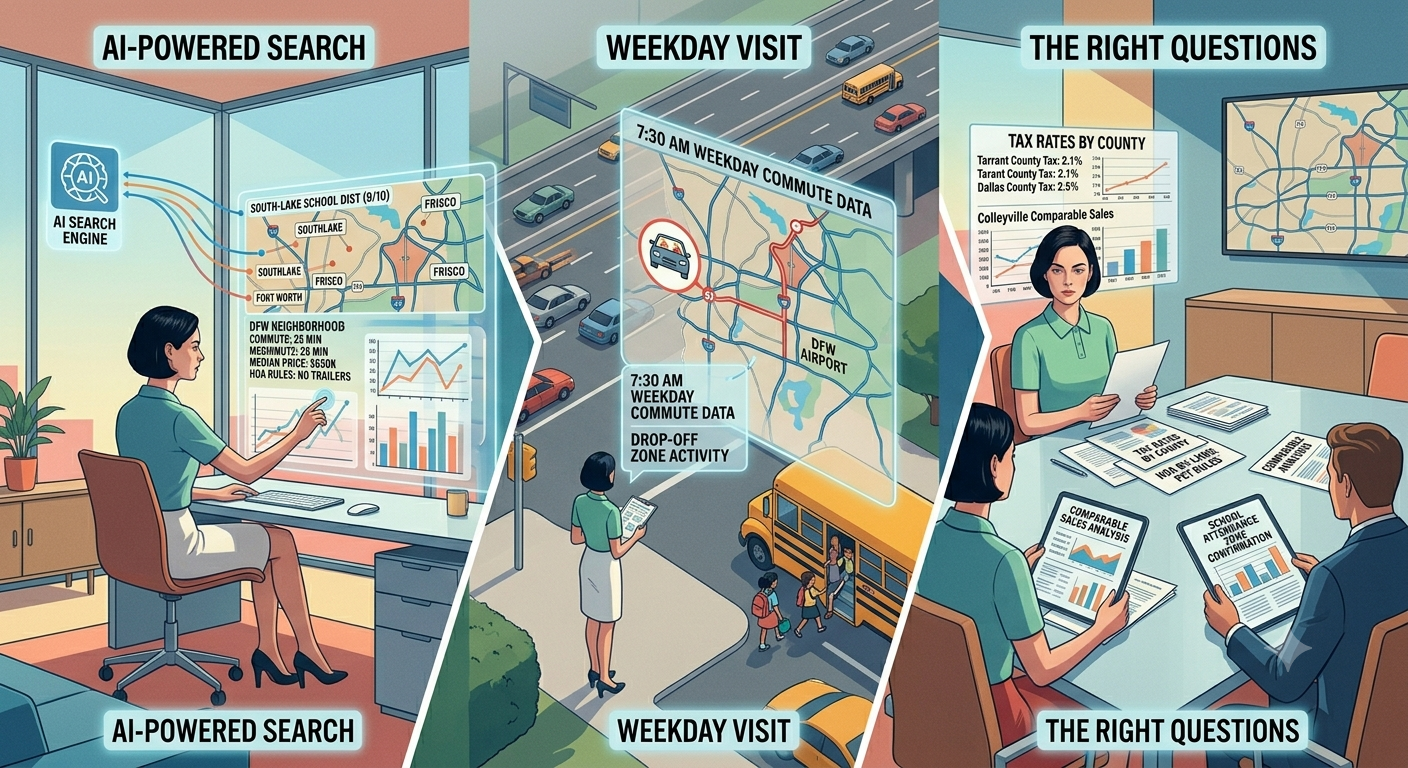
Use AI-Powered Search Tools to Surface the Right Options Faster
One of the challenges of relocating to a market as large as DFW is that traditional search methods surface too many results without enough context to evaluate them meaningfully. AI-powered property search tools change that equation by identifying communities that match your specific combination of budget, school district, commute corridor, and home criteria, and presenting them in a way that allows for real comparison rather than endless scrolling. Working with a broker who uses these tools means your short list is built from actual data, not guesswork.
Visit During the Week, Not Just on Weekends
Weekend visits to DFW neighborhoods show you the best version of each area. Weekday mornings and evenings show you the reality of daily life: traffic patterns, school drop-off activity, neighborhood noise levels, and commute times under real conditions. If at all possible, visit properties you are seriously considering during a weekday window before you go under contract. An hour spent driving the commute route at 7:30 in the morning can save you years of daily frustration.
Ask the Right Questions Before You Make an Offer
Before writing an offer on any property in DFW, confirm the school attendance zone for that specific address, not just the district name. Verify HOA rules, fees, and any assessments that are not immediately visible in the listing. Check the tax rate for the specific county and city, since rates vary across the metroplex. And have your broker pull comparable sales to confirm that the price you are offering reflects actual market value for that area. A broker with deep DFW knowledge makes each of these steps efficient rather than overwhelming.
Key Takeaways
DFW is too large and too varied to approach without a clear priority list; start with your workplace location and commute tolerance before anything else
The Dallas and Fort Worth sides of the metroplex have meaningfully different community characters, price profiles, and market dynamics
School district boundaries affect both your daily life and your long-term resale value, regardless of whether you have school-age children
AI-powered search tools help relocating buyers build a smarter, faster short list in a market this large
An experienced Texas Broker who knows DFW specifically is one of the most valuable resources a relocating buyer can have
Internal Link Suggestions
Discover why working with a Texas Broker matters for buyers and sellers
Find out how AI is changing real estate for Texas buyers and sellers
Schedule a private AI-powered seller or buyer strategy consultation
FAQ Section
Q: How do I start narrowing down neighborhoods when relocating to DFW? Start with your workplace address and your maximum acceptable commute time. That single filter eliminates a large portion of the metroplex immediately and focuses your search on areas where daily life will actually work. From there, layer in your priorities in order: school district, price range, home style, and community feel. A broker who specializes in DFW relocations can match those priorities to specific communities and save you significant time and guesswork.
Q: Is Dallas or Fort Worth better for buyers relocating to the area? Neither is universally better. Dallas and its northern suburbs tend to carry higher price points and offer a more urban or high-density suburban feel. Fort Worth offers more value per square foot in many price ranges, a distinct cultural identity, and a slower-paced community character. The right choice depends on where you work, what your budget is, and what kind of daily environment fits your life. Many buyers who overlook Fort Worth initially find it becomes their preferred option once they spend time there.
Q: How much do school districts affect home values in DFW? Significantly. Homes in highly rated school districts in Collin and Tarrant County carry measurable premiums over comparable homes in districts with lower ratings. Those premiums persist at resale, which makes school district an important consideration even for buyers without school-age children. Always verify the specific attendance zone for any address you are considering, since district boundaries and zone assignments do not always match neighborhood names or zip codes.
Q: What is driving home prices up in Collin County communities like Frisco and McKinney? The combination of highly rated school districts, significant employer presence, newer housing stock, and sustained in-migration from other states has kept demand strong in Collin County for over a decade. Both Frisco and McKinney have added corporate campuses, retail developments, and community amenities that reinforce their desirability. Supply has grown with new construction, but demand has consistently kept pace. Buyers entering this market should be prepared for active competition in the most sought-after price ranges.
Q: Do I need a local DFW broker to buy a home there, or can I use someone from my current city? You need someone who knows DFW specifically, not just someone licensed in Texas. The metroplex is too large and too varied for general knowledge to serve you well. A broker who works in DFW regularly understands current market conditions by submarket, knows which neighborhoods are appreciating and which are plateauing, and can advise you in real time when you are under contract. That local depth is not optional in a relocation purchase. It is one of the most important decisions you make in the process.
Q: How do AI-powered search tools help buyers relocating to DFW? AI-powered property search tools analyze your criteria, including price range, school district, commute corridor, and home features, and surface matching properties faster and more accurately than traditional MLS searching allows. In a market as large as DFW, this means you spend less time scrolling through irrelevant listings and more time evaluating properties that actually fit. Combined with a broker who interprets those results with real local knowledge, AI search tools make the relocation process significantly more efficient.
"In DFW, the right neighborhood is not the one that looks best online. It is the one that works best in your actual daily life." — Sharon Yeary, Texas Broker | Sharcom Realty | 832-388-9945 | SharcomRealty.com

Relocating to DFW? Let's Find the Right Community Before You Fall in Love With the Wrong One.
The right neighborhood search in Dallas-Fort Worth starts with real priorities and local knowledge, not just a list of popular zip codes. Let's map out your criteria together and use AI-powered search tools to find the communities that actually fit your life.
Ask about my AI-powered home search and pricing strategy to help you make smarter moves faster.