
Myths About Selling Homes Fast in Grapevine TX
The Biggest Myths About Selling Homes Fast in Grapevine
About the Author: Sharon Yeary is a licensed Texas Broker, Broker/Owner of Sharcom Realty, and a HAR Platinum Real Estate Agent with more than 26 years of experience serving buyers and sellers across Katy, Houston, Fulshear, and Dallas-Fort Worth. She is a certified instructor at Champions School of Real Estate, a Contract Instructor and Facilitator with the Texas Association of REALTORS, and an AI-certified real estate professional. Phone: 832-388-9945 | SharcomRealty.com
Table of Contents
What Sellers in Grapevine Believe That Costs Them a Sale
Quick Answer: What Are the Biggest Myths About Selling Fast in Grapevine?
Why Grapevine Sellers Are Especially Susceptible to These Myths
Pricing Myths That Slow Grapevine Sales Down
Preparation and Presentation Myths
Timing and Offer Strategy Myths
Marketing Myths That Mislead Sellers
Key Takeaways
FAQ
Work With Sharon
What Sellers in Grapevine Believe That Costs Them a Sale
Grapevine sellers do not go into the market planning to make mistakes. They go in with the best information available to them, which often means advice from neighbors, family members who sold a house a decade ago, and the internet. The problem is that a lot of that advice is outdated, oversimplified, or simply wrong for the way the Grapevine market actually works today.
The myths about fast home sales are particularly dangerous because they feel reasonable. They are built on partial truths and logical-sounding logic. A seller who believes them may not realize anything is wrong until the listing has been sitting for three weeks, the showing activity has dried up, and the offers they do receive are lower than what they expected when they first went live.
I am Sharon Yeary, Texas Broker and Broker/Owner of Sharcom Realty. I have sold homes in the DFW market, including Grapevine, for more than 26 years. The sellers I work with who come to me after a failed listing almost always believed at least one of the myths in this post. This guide names them directly so you can go into your sale with a clear, accurate picture of what actually drives a fast, strong result in the Grapevine market.
Quick Answer: What Are the Biggest Myths About Selling Fast in Grapevine?
Here is the short version:
"The market will carry any price" is the myth that causes the most damage. Even in an active market, overpriced listings sit while well-priced ones sell
"Buyers will see past the condition and presentation" is consistently wrong. Buyers in Grapevine have options, and they choose homes that are ready, not ones that require imagination
"The first offer is never the best offer" causes sellers to reject or counter aggressively on the offer most likely to close, and then watch the listing age
"I should wait for spring" ignores the reality that motivated buyers exist year-round and that peak listing seasons mean peak competition from other sellers
"More marketing activities means faster sales" misunderstands the difference between activity and strategy. A targeted, well-timed approach outperforms volume every time
"I can start high and reduce later without losing momentum" is the pricing myth that produces the most regret, because the reduction never fully recovers the lost first-week energy

Why Grapevine Sellers Are Especially Susceptible to These Myths
Grapevine is a market that genuinely has a lot going for it. Its location near DFW International Airport, its historic Main Street district, access to Grapevine Lake, Grapevine-Colleyville ISD, and proximity to major employment corridors make it a community that buyers actively seek out. Sellers who know this sometimes take the community's appeal as a guarantee that their specific home will sell quickly regardless of how it is priced, prepared, or marketed.
That confidence is understandable and it is also where the myths take root. A community's overall desirability does not transfer automatically to every listing within it. Buyers choosing between four comparable Grapevine homes in the same price range will choose based on price accuracy, condition, presentation, and the impression the home makes during the showing. The community's appeal brought them to Grapevine. The listing's quality determines which home they buy.
The Grapevine market also draws a significant number of relocation buyers, many of them arriving from out of state with employer assistance, compressed timelines, and professional buyer representation that knows the DFW market well. These buyers are not easily impressed by a home that is overpriced or underprepared. They have seen enough to know the difference.
Pricing Myths That Slow Grapevine Sales Down
Myth: "The Market Is Hot, So Any Price Will Work"
This is the most costly myth in the Grapevine seller playbook, and it is especially tempting when sellers hear about neighbor's homes selling quickly above list price. What those stories rarely include is the full context: how the home was prepared, whether the price was strategically set to attract multiple offers, and what the specific competitive landscape looked like at the time.
An active market does not mean buyers will pay any price for any home. It means that well-priced, well-presented homes sell quickly and with competition. A home priced above what the comparable sales and current competition support will sit in any market, including an active one, because the buyers most likely to close on it are searching in the price range that reflects its actual value, not the range the seller wishes it occupied.
Myth: "I'll Start High and Come Down If I Need To"
This is the second most common pricing myth, and it is related to the first. Sellers who price above market with the plan to reduce when activity stalls are not building in negotiating room. They are sacrificing the first-week momentum that typically determines whether a home sells in two weeks or two months.
The buyers most motivated to purchase in Grapevine right now see new listings the moment they go live. When those buyers review the listing at the initial price and find it above their expectation of value, they move on. By the time the seller reduces, those buyers have often already gone under contract on another property. The reduced listing does not attract the same quality of buyer interest that a correctly priced launch would have generated because the moment when the most motivated buyers were shopping has already passed.
Myth: "My Home Is Special, So Standard Market Data Doesn't Apply"
Every seller believes their home has something that justifies a price premium. Sometimes they are right. A gut-renovated kitchen, a pool, or a primary suite addition can legitimately support a higher price. But the premium has to be grounded in what buyers in the current Grapevine market are actually paying for those features, not in what the seller invested to create them. Renovation cost and market value are not the same number, and the gap between them is where pricing myths do the most damage.
Preparation and Presentation Myths
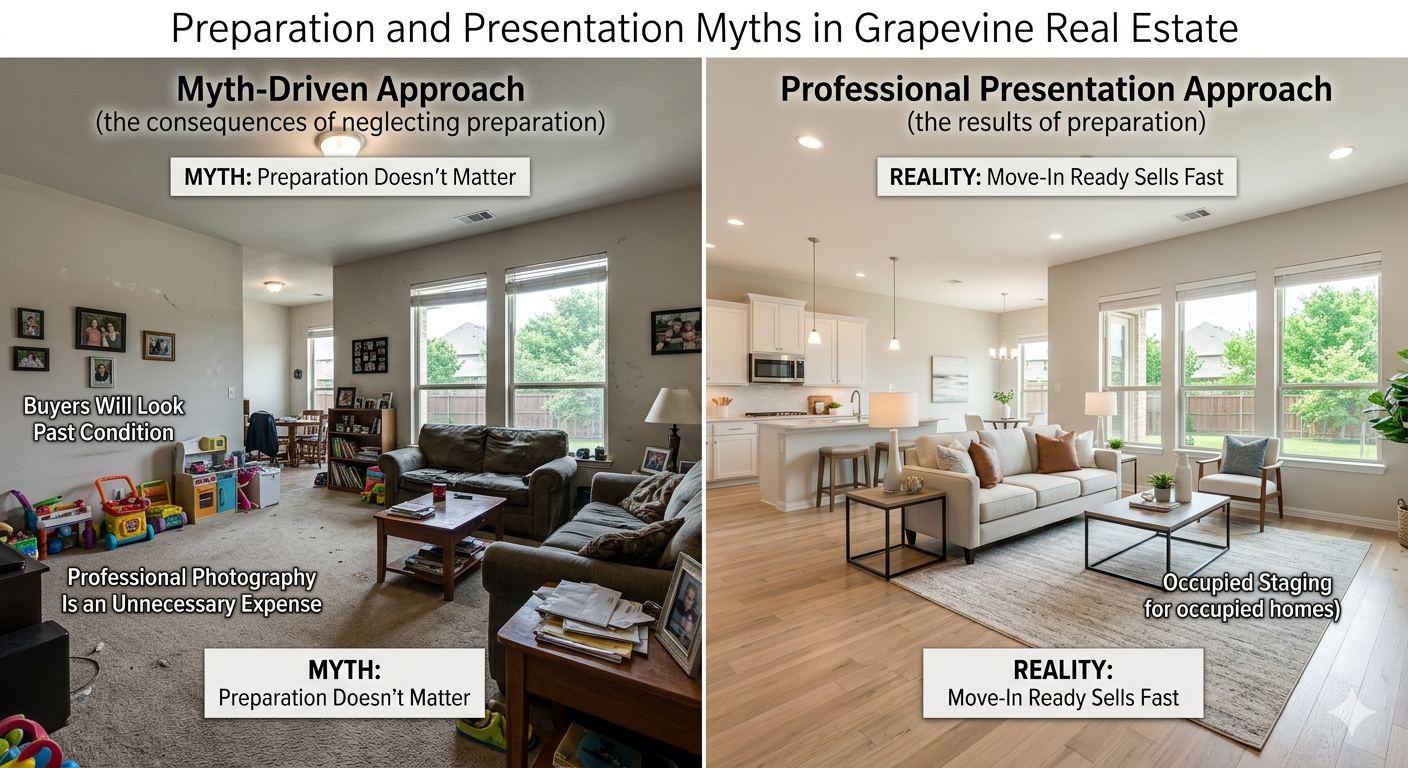
Myth: "Buyers Will Look Past the Condition"
In theory, a motivated buyer can look past cosmetic issues and dated features to see a home's potential. In practice, the Grapevine buyer who is comparing your home against three or four alternatives that are move-in ready will choose the move-in ready option. The cost of imagining a renovation, dealing with the hassle of post-closing work, and taking on the uncertainty of what additional issues might exist beneath the surface all get priced into any offer the buyer makes on a home that requires work.
Preparation does not require a full renovation. It requires that the home be clean, well-maintained, freshly touched up where needed, and presented in a way that communicates care. Buyers who walk into a home and feel that care respond differently than buyers who walk in and immediately start calculating what they will need to address. That difference shows up in offer prices.
Myth: "Professional Photography Is an Unnecessary Expense"
Sellers sometimes resist the cost of professional photography, particularly in a market where they believe their home will sell quickly regardless. This logic has the sequence backwards. Professional photography is not insurance for a slow-selling home. It is part of what creates the conditions for a fast sale by generating strong click-through rates on digital platforms, producing a primary listing image that earns buyer attention in a competitive search result, and setting the showing expectation at the level the home deserves.
The buyer who does not click on a listing because the photos are dark, poorly composed, or fail to capture the home's best features never schedules a showing. Showings drive offers. Professional photography drives showings. Skipping it to save a few hundred dollars in a transaction involving hundreds of thousands of dollars is exactly the kind of false economy that costs sellers far more than it saves.
Myth: "Staging Is Only for Empty Homes"
Many occupied Grapevine sellers assume that since their furniture is already in the home, staging is not relevant to them. Professional staging for occupied homes is a different service than staging an empty property, but it is not any less valuable. An occupied staging consultation identifies furniture arrangements that improve flow and sightlines, removes personal items that reduce the buyer's ability to project themselves into the space, and edits the visual environment to work with the home's photography and showing experience. The difference between a well-edited occupied home and one that simply has furniture in it is visible in both the photographs and the showing, and buyers respond to it.
Timing and Offer Strategy Myths
Myth: "Spring Is the Only Good Time to Sell in Grapevine"
Spring is an active listing season in the DFW market, including Grapevine. It is also a season when more sellers are listing, which means more competition for the same pool of buyers. A seller who lists in October or February in a well-priced, well-presented condition often encounters buyers who have been actively searching for months with less to evaluate. Those buyers can be highly motivated and financially ready in ways that spring buyers, still early in their search process, may not be.
The best time to sell a Grapevine home is when your specific circumstances are aligned: the home is prepared, the price is grounded in current data, and your personal timeline supports the process. Waiting for spring because of a general belief that it is always better often means competing against a larger inventory and sacrificing the seller's advantage that comes from being one of the better options in a thinner market.
Myth: "The First Offer Is Always Too Low"
This is one of the most reliably costly myths in the offer stage of a Grapevine sale. The first offer on a correctly priced, well-presented listing often comes from the buyer who has been most actively searching in that price range and who recognized immediately that the home was worth acting on. That buyer's first offer may be structured conservatively, but it reflects genuine intent from a motivated, qualified buyer.
Sellers who dismiss or counter aggressively on the first offer because they believe something better is coming often find themselves with an expired option period, a buyer who walked, and a listing that now has days on market working against it. The question to ask is not whether the first offer is the highest possible number. It is whether this buyer, at this price, with these terms, is the best realistic outcome available. Your broker should help you answer that question accurately, not with optimism.
Myth: "If I Wait, a Better Offer Will Come"
Related to the first-offer myth is the broader belief that patience in offer evaluation always pays. Sometimes it does. Sometimes the seller who waits a few days to see if competing interest develops gets a second offer that is meaningfully stronger. But in a market where the best buyers move quickly and where days on market accumulate visible cost, waiting without a clear strategic reason is a gamble that sellers often lose. The home that was generating showing activity in week one generates less in week three, and the offer that felt inadequate in week one may look considerably better in retrospect.

Marketing Myths That Mislead Sellers
Myth: "More Marketing Activities Always Equal Faster Sales"
Sellers sometimes measure marketing effort by activity volume: how many platforms the listing appears on, how many open houses are held, how many mailers were sent. These are not irrelevant, but they are not what drives the result. What drives a fast Grapevine sale is targeted, well-timed marketing that reaches the specific buyers most likely to close on your property, at the moment when their interest and readiness to act are aligned.
AI-powered buyer targeting identifies those buyers by analyzing behavioral data, search patterns, and comparable purchase history, and delivers the listing directly to them across the channels they use. One well-targeted impression in front of the right buyer is worth more than a hundred impressions in front of people who are not in the market, not qualified, or not looking for a home like yours.
Myth: "My Home Will Sell Itself — It Just Needs to Be Listed"
In a slow market, this myth is obviously wrong. In an active market, it is less obviously wrong but still consistently costly. A home that is simply listed without professional photography, strategic pricing, targeted marketing, and broker-to-broker outreach will sell eventually. The question is whether it sells in week one to a competitive field of motivated buyers, or in week six to a buyer who made a low offer because the listing had been sitting long enough to invite it.
The Grapevine market rewards preparation and strategy just as reliably as it punishes their absence.
Key Takeaways
The most damaging myths about fast home sales in Grapevine all share a common thread: they substitute assumption for strategy
Overpricing, even in an active market, eliminates the best buyers and produces the slow, painful sale sellers were trying to avoid
Preparation and presentation are not optional extras for a fast sale. They are what creates the first impression that motivates serious buyers to act
The first offer on a well-priced listing frequently comes from the most motivated buyer. Dismissing it without careful evaluation is a common and costly error
Targeted marketing, grounded in AI-powered buyer data and broker relationships, outperforms volume-based approaches in both speed and outcome
Internal Link Suggestions
Read about why smart Houston buyers are looking beyond downtown for better value
Discover are open houses still effective in Dallas and what actually sells homes faster
Schedule a private AI-powered seller or buyer strategy consultation
FAQ Section
Q: Why is my Grapevine home not getting offers even though the market seems active? The most common reasons a Grapevine listing generates showing activity but no offers are price, presentation, or a combination of both. If buyers are touring the home but not making offers, the showing experience is not matching their expectation given the price. Your broker should review buyer feedback from showings, compare your active competition, and assess whether a price adjustment, a presentation improvement, or both are indicated. In most cases, the market is telling you exactly what the problem is. The challenge is hearing that clearly rather than waiting for the right buyer to appear.
Q: Is it true that the first offer is usually too low in Grapevine? Not as a reliable rule. The first offer on a correctly priced, well-presented Grapevine listing often comes from the most motivated buyer who has been actively searching in that price range and recognized the home's value immediately. That offer may not be at full asking price, but it frequently represents the best realistic outcome available at the time. Sellers who counter aggressively expecting something better often find that the buyer walks and the next offer comes later, from a less motivated buyer, after days on market have accumulated and reduced the seller's negotiating position.
Q: Does the time of year really affect how fast a Grapevine home sells? Seasonality is real but overrated as a deciding factor. Spring brings more buyers and more competition from other sellers listing simultaneously. Fall and winter bring fewer buyers but also fewer competing listings, which often means the buyers who are active are more motivated and have less to choose from. The most important timing variable is not the season. It is whether your home is properly prepared and priced when it goes live. A strong listing in October will outperform a weak listing in April every time.
Q: How much does professional photography really affect the outcome of a Grapevine sale? Significantly and measurably. The primary listing photo determines whether a buyer clicks into the full listing or scrolls past it. In a market where buyers are evaluating many listings from a phone screen, the quality of the exterior and interior photography directly determines showing volume. Listings with professional photography consistently generate more showing requests than listings with phone photos or poor-quality images, even when the homes themselves are comparable. The cost of professional photography is one of the highest-returning presale investments available to a Grapevine seller.
Q: What is the real difference between targeted marketing and just putting the listing on more platforms? Putting a listing on more platforms distributes it more widely but does not necessarily reach the right buyers more effectively. A buyer who is not actively searching in Grapevine's price range seeing your listing on ten platforms is less valuable than a qualified, motivated buyer in that exact range seeing it on two. AI-powered buyer targeting identifies buyers by their behavior: what they have searched, what comparable homes they have viewed, how recently they have been active, and whether their profile matches the specific criteria that align with your home. That specificity produces better results than volume-based distribution because it concentrates impressions on the people most likely to schedule a showing and make an offer.
Q: Can I sell my Grapevine home without an agent using a flat-fee MLS service? You can list your home without an agent, but selling it without one is a different matter. FSBO sellers in Grapevine face the same pricing, presentation, and negotiation requirements as any other listing, without the broker expertise, market relationships, contract knowledge, and negotiating experience that a professional brings. Research consistently shows that FSBO homes sell for less than professionally listed homes on a median price basis. In a market like Grapevine where buyers have experienced representation, a seller who is representing themselves is typically at a structural disadvantage from the first offer through closing.
"In Grapevine, the sellers who move fastest are not the ones with the most confidence in the market. They are the ones who prepared for it." — Sharon Yeary, Texas Broker | Sharcom Realty | 832-388-9945 | SharcomRealty.com

Myths Do Not Sell Homes in Grapevine — Strategy Does
If you want to sell your Grapevine home fast and at the right price, the path forward starts with the truth about what the market actually responds to. Let's build a listing strategy grounded in real data, targeted marketing, and 26 years of DFW experience so your home performs from day one.
Ask about my AI-powered home search and pricing strategy to help you make smarter moves faster.