
Your Listing Expired — Here's What to Do Next in the Dallas-Fort Worth Market (June 2026)
Did Your Listing Expire? Here Is What to Do Next in the Dallas-Fort Worth Market
An expired listing in the Dallas-Fort Worth market is not a permanent verdict. It is a diagnosis that has not been made yet. The home did not fail. The strategy did. And in a market as active as DFW, the gap between a failed listing and a successful one is almost always smaller than sellers assume when they are sitting in the middle of the frustration.
I am Sharon Yeary, Texas Broker and Broker/Owner of Sharcom Realty. I hold a HAR Platinum designation from the Houston Association of REALTORS and have been licensed in Texas real estate for more than 26 years. I am a certified instructor at Champions School of Real Estate, a Contract Instructor and Facilitator with the Texas Association of REALTORS, and an AI-certified real estate professional. I have relisted and sold homes across the Dallas-Fort Worth metro that other brokers could not move, and I have done it consistently enough to know that the pattern behind every expired listing is almost always identifiable, addressable, and correctable.
This post is built around the five questions I hear most often from DFW sellers whose listings have expired. The answers are direct, specific to this market in June 2026, and grounded in what I have actually seen work and fail across hundreds of transactions in this metro.
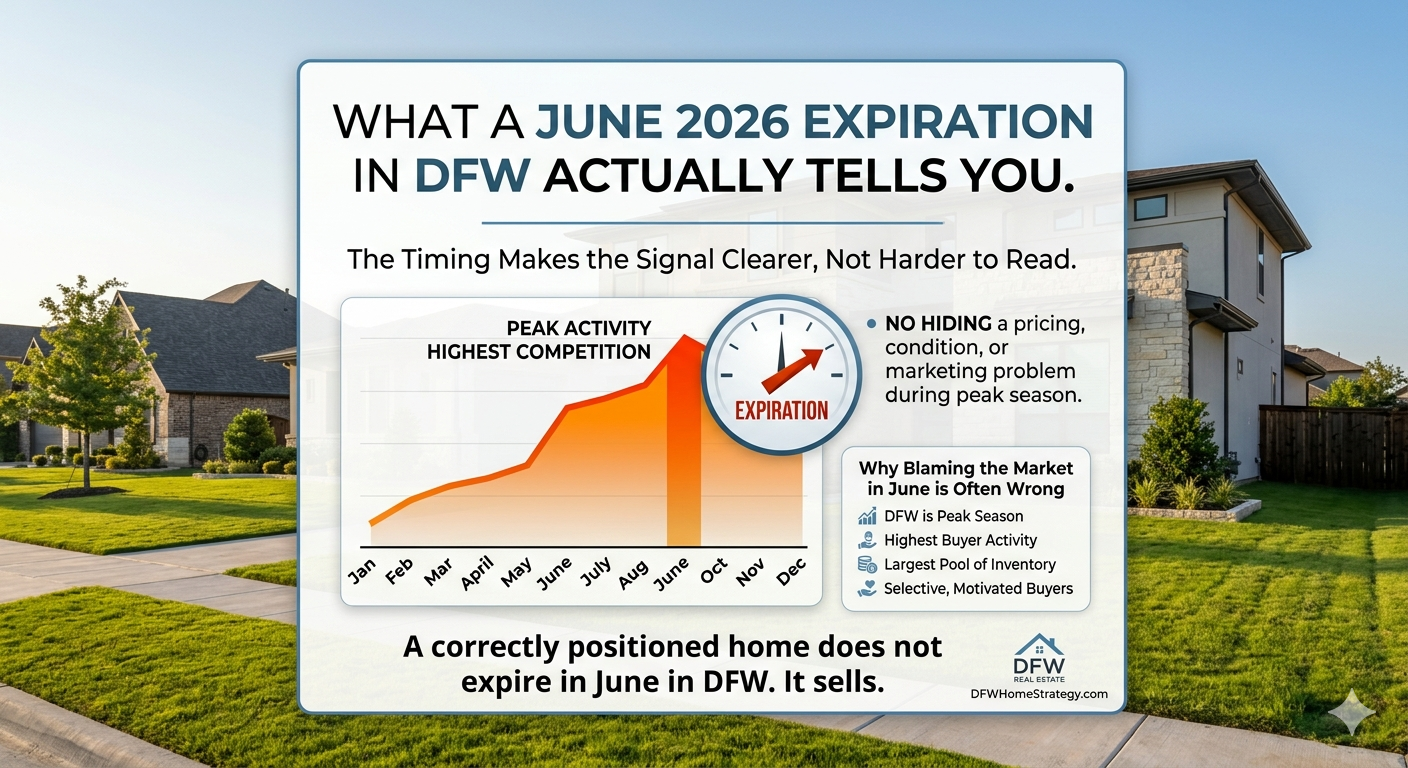
What a June 2026 Expiration in DFW Actually Tells You
The first thing I want to address is timing, because a lot of sellers with expired listings assume that their experience reflects something going wrong in the broader market. In most cases, it does not.
The Timing Makes the Signal Clearer, Not Harder to Read
June in the Dallas-Fort Worth market is peak season. It is when inventory is highest, buyer activity is highest, and competition among both sellers and buyers is most intense. A home that expires in June was competing against the largest pool of available inventory of the year while simultaneously being evaluated by the largest pool of active, motivated buyers. That combination means there was no hiding a pricing problem, a condition problem, or a marketing problem. Everything shows in a competitive market, and June in DFW is about as competitive as it gets.
When a DFW home expires in June, the signal is unusually clear: something was meaningfully wrong with the strategy, not marginally off. A home priced correctly, presented well, and in acceptable condition does not expire in peak season in a metro that adds hundreds of thousands of new residents every year. It sells.
Why Sellers Who Blame the Market in June Are Usually Wrong
I hear a version of the same explanation from sellers with expired listings regardless of market conditions. The market was slow. Buyers were waiting. Interest rates scared people off. These things can all be contributing factors in weak seasons. In June in DFW, they are rarely the primary explanation.
The DFW market in June 2026 has more inventory than the peak competition years, which is true and meaningful for buyers. But more inventory does not mean a soft market. It means a more selective market. Buyers have options, and they are using them to compare your home directly against every other home at your price point that is active on the same day. A home that does not compete well in that comparison does not receive offers, not because the market failed, but because the strategy did not position it to win.
The DFW-Specific Factors That Quietly Kill Listings in This Market
Beyond the standard reasons listings expire anywhere, there are factors specific to the Dallas-Fort Worth market that I address in every relisting conversation because they appear repeatedly as silent contributors to stalled listings that sellers and their prior brokers did not identify.
School District Positioning and Buyer Verification
In DFW, school district assignment is not a soft selling point. It is a hard filter that a large segment of the buyer pool applies before scheduling a showing. The DFW metro has a patchwork of school district boundaries that do not always align intuitively with city or neighborhood names, and buyers who are prioritizing specific districts, whether Frisco ISD, Carroll ISD, Keller ISD, or others, are verifying district assignment before they ever contact an agent.
A home priced as though it sits within a highly sought-after ISD when buyers discover it actually falls outside that district's boundaries will lose those buyers immediately and permanently. I have reviewed expired listings where the school district information in the marketing materials was accurate but the pricing implicitly positioned the home in a more desirable academic category than the actual district supported. Buyers figured it out. The showing traffic stopped. The listing sat.
Before any relaunch, I verify school district assignment directly with the district, confirm it is correctly reflected in the listing, and ensure the pricing strategy is calibrated to what homes in that specific district are actually trading for in the current market.
HOA Documentation Gaps in Master-Planned DFW Communities
The Dallas-Fort Worth metro is home to some of the most extensive master-planned communities in the country. Viridian in Arlington, Stonebridge Ranch in McKinney, Star Trail and Windsong Ranch in Prosper, Walsh in Fort Worth, and dozens of others all have HOA structures that buyers examine carefully. They want to know what the monthly dues cover, what the restrictions include, whether there are pending special assessments, and what the community's financial reserves look like.
Listings that have incomplete or outdated HOA documentation create a friction point that motivated buyers experience as a red flag rather than a paperwork gap. I have watched deals fall apart during the option period specifically because HOA documents that should have been available at the time of the listing were not produced until the buyer requested them, which created the impression that the seller had something to conceal. In a relaunch, having complete, current, and proactively available HOA documentation is a competitive advantage that sellers in non-HOA communities do not even have to think about.
The Commute Reality That Listing Descriptions Cannot Overcome
Dallas-Fort Worth traffic is among the most studied and documented in the country, and DFW buyers know it intimately. A listing that describes a home as convenient to major employment corridors when the actual commute during peak hours is 55 minutes in a single direction will generate showings from buyers who discover the commute reality either during their research or after their first visit to the property, and then choose not to offer.
I am careful in every listing I take to describe proximity accurately and to position the home for the buyer profile for whom the commute is actually reasonable. A home in Grand Prairie that serves DFW Airport employees or mid-cities employers is positioned differently than a home marketed to Downtown Dallas professionals. Matching the marketing to the realistic buyer profile eliminates the showing traffic that generates no offers and focuses attention on buyers for whom the home genuinely works.

What a Correct DFW Relaunch Looks Like in June 2026
A relaunch is not a relist. Changing the broker, resetting the days on market counter, and hitting publish again on essentially the same listing produces essentially the same result. The sellers who change their outcome do so because they change their strategy in ways that address the specific reasons the first listing failed.
Step One: The Full Audit Before Anything Goes Back on the Market
The first thing I do with every expired DFW listing I take over is an audit, not a sales pitch. I pull the prior listing's showing data: how many showings were scheduled, how many occurred, how many generated feedback, and what that feedback said. I look at any failed deal history, including inspection reports from deals that fell through during the option period. I review the prior pricing history, including any reductions that happened during the listing period and how buyer behavior responded to them.
This audit takes time and it requires access to information that sellers sometimes have to request from their prior broker. It is worth every bit of that effort because it converts a frustrating experience into a data set. Every showing that ended without an offer was a buyer telling the market something about the home. Reading that signal correctly is what makes the relaunch different from the original listing.
Step Two: Real-Time Market Analysis Against Current Competition
The market that exists today in the DFW metro is not the same market that existed when your home first listed. Inventory levels have changed. Competing homes have come and gone. Buyer behavior at your price point has shifted. Pricing trends in your specific submarket have moved in ways that may not be fully captured in a traditional comparative market analysis that relies heavily on closed sales from the prior 90 to 180 days.
As an AI-certified broker, I build a real-time market analysis that layers current buyer search activity, active competing inventory at your price point today, recent price reduction patterns in your submarket, and days on market trends for comparable homes. This analysis is run fresh before every relaunch because the pricing decision should reflect what buyers are doing right now, not what they were doing when the original listing went live.
For relaunched DFW listings, I also pull current data from the Collin Central Appraisal District, the Tarrant Appraisal District, and the Dallas Central Appraisal District as appropriate for the property's location to ensure that the assessed value baseline and tax rate implications are factored into the buyer's total cost of ownership calculation. In DFW, where effective property tax rates commonly run between 2.0% and 2.8% of assessed value, the monthly cost of ownership is meaningfully different from the mortgage payment alone, and pricing that does not account for that reality leaves sellers vulnerable to offers that fall apart when buyers do their own math.
Step Three: Fresh Eyes on the Physical Showing Experience
Sellers who have lived in or been closely involved with a home for an extended listing period stop seeing what buyers see. The scuff on the baseboard in the hallway that every buyer notices has become invisible to the seller. The layout challenge in the kitchen that generates consistent feedback has been normalized. The backyard that photographs poorly because of the angle the listing photographer used has been accepted as the backyard's limitation rather than recognized as a photography failure.
Before every relaunch, I walk the home with fresh eyes and I bring someone who has not been inside it before, sometimes a colleague, sometimes a stager, sometimes both. The goal is to see the home as a buyer who has no emotional investment in it will see it on a Tuesday afternoon. What they notice is what the next buyer will notice. Addressing those observations before relisting, whether through a minor repair, a staging adjustment, or a photography reshoot, converts passive showing traffic into offers.
Step Four: Updated Photography and Listing Copy That Reflects What Changed
If the relaunch strategy has produced meaningful changes, whether in price, in physical condition, in staging, or in the features being highlighted, the listing materials have to reflect those changes. Relaunching with the original photography and listing description tells buyers and their agents that nothing has changed, which removes the most important signal the relaunch needs to send.
Updated professional photography is not optional for a DFW relaunch. It is the visual evidence that something is different this time, and it is the mechanism through which a buyer who scrolled past the original listing considers this version of it with fresh attention.
Overcoming the Days on Market Concern
The question I hear most often from DFW sellers who are ready to relaunch is some version of: will buyers penalize me for the listing history? The honest answer is that some will try, and the right preparation makes that negotiating position significantly weaker.
Why Buyers Ask and What the Right Answer Actually Is
When a buyer's agent sees a home with 60 or 90 days of prior listing history, they will ask why it did not sell. That question is not going away and it should not be avoided. The answer that resolves the concern is not a market explanation. It is a specific, honest account of what was wrong and what has changed.
A seller who can say that the original pricing was above what the current market data supports and the home is now listed at a price grounded in a fresh comparative analysis, that the inspection from a failed option period deal identified two items that have since been repaired, and that the photography has been updated to correctly show features the original listing did not communicate well has answered the question. That answer does not eliminate every buyer's skepticism. But it gives a motivated buyer a reason to move forward that a vague "we decided to make a change" never would.
The Relaunch That Answers the Question Before It Gets Asked
The best version of a relaunch is one where the changes made are visible in the listing itself before a buyer has to ask. A price that is clearly grounded in current market data, photography that shows the home better than the previous version, a listing description that addresses features the original version did not highlight, and available documentation of any repairs or improvements completed since the prior listing all communicate proactively that the relaunch is substantively different from the original.
Sellers who relist with nothing changed except the broker name on the listing give buyers no reason to believe this attempt will be different. Sellers who relaunch with a demonstrably improved presentation and a defensible pricing position give buyers a reason to write an offer they did not have before.

A Real DFW Relaunch Story and What It Shows
The pattern I have described above is not theoretical. I have worked through it with sellers across the DFW metro, and the outcomes are consistently better when the process is applied thoroughly than when sellers push back on any part of it.
The Frisco Home That Sat for 81 Days and Sold in Nine
I relisted a home in Frisco that had been on the market for 81 days with a prior broker. The original list price was $575,000, set based on comparable sales from the prior quarter. When I ran a real-time analysis of the current active competing inventory in that specific section of the community, the data consistently supported a range of $545,000 to $552,000. The market had shifted in the months since the original comps were pulled, and the home had been priced above where buyers were willing to offer.
The prior listing also had a photography problem. The covered back patio, which was a genuinely attractive feature and one that would have differentiated the home from competing listings without covered outdoor space, was not shown effectively in any of the original photos. A buyer scrolling through the listing would not have known the covered patio existed from the photography alone.
We relisted at $549,000. We reshoot the backyard with the patio properly lit and staged. We addressed two minor items that had been flagged in showing feedback from the original listing period. The relaunch went live on a Thursday. The home received three offers by the following Saturday and closed at $553,000. My seller netted more at $553,000 on the relisted price than they would have after continued slow price reductions from $575,000, and they closed in summer rather than carrying the property into fall.
What the Story Shows About Your Listing
The Frisco situation was not unusual. The original broker was not incompetent. The home was not a problem property. The pricing was based on data that had become stale, and the photography failed to show one of the home's best features. Two correctable problems produced an 81-day failure. Two specific corrections produced a nine-day success.
Your listing has a version of this story. Something specific did not work. Identifying it precisely and addressing it before the relaunch is the entire difference between a second attempt that produces a different result and a second attempt that produces more of the same.
Your Next Step If Your DFW Listing Has Expired
If your Dallas-Fort Worth listing has expired and you are ready to approach it correctly this time, the conversation starts with a full diagnostic, not a listing agreement. I want to understand what happened with the prior listing before I tell you what needs to change.
That conversation is available to any DFW seller whose listing has expired, regardless of price point or prior broker relationship. Call me directly at 832-388-9945 or schedule a seller consultation at SharcomRealty.com.
The market that could not sell your home under the previous strategy is the same market that can sell it under the right one. The goal is to figure out exactly what right looks like for your specific home, your specific submarket, and the buyers who are actively looking in June 2026.