
Negotiation Tactics Sellers Miss in The Woodlands TX
The Most Overlooked Negotiation Tactics for Sellers in The Woodlands
About the Author: Sharon Yeary is a licensed Texas Broker, Broker/Owner of Sharcom Realty, and a HAR Platinum Real Estate Agent with more than 26 years of experience serving buyers and sellers across Katy, Houston, Fulshear, and Dallas-Fort Worth. She is a certified instructor at Champions School of Real Estate, a Contract Instructor and Facilitator with the Texas Association of REALTORS, and an AI-certified real estate professional. Phone: 832-388-9945 | SharcomRealty.com
Table of Contents
What Most Sellers Miss Before the First Counteroffer
Quick Answer: What Are the Most Overlooked Negotiation Tactics for Sellers in The Woodlands?
Why Negotiation in The Woodlands Requires a Specific Approach
Understanding the Buyer's Motivation Before You Respond
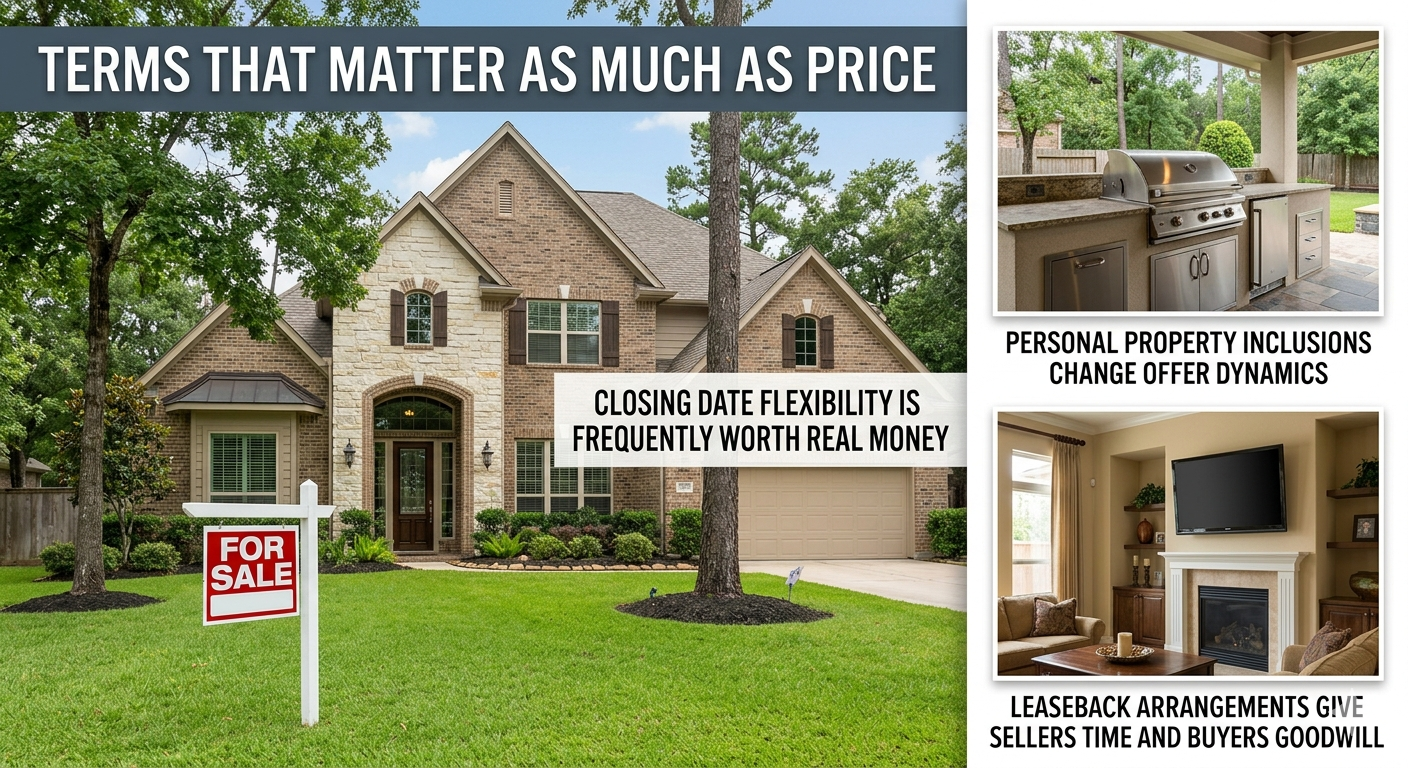
Terms That Matter as Much as Price
The Inspection Negotiation: Where Woodlands Sellers Give Too Much
Appraisal Gaps, Counteroffers, and How to Hold Your Position
Key Takeaways
FAQ
Work With Sharon
What Most Sellers Miss Before the First Counteroffer
Most sellers think of negotiation as the moment they receive an offer and decide how to respond. By that point, several of the most important negotiating decisions have already been made, and some of the most valuable leverage has already been spent without the seller realizing it.
Negotiation in The Woodlands real estate market is not a single moment. It is a process that begins before the listing goes live and continues through inspection, appraisal, and closing. Sellers who understand the full arc of that process, and who have a broker guiding them through each stage with a clear strategy, consistently walk away with better outcomes than sellers who are reacting to each new development as it arrives.
I am Sharon Yeary, Texas Broker and Broker/Owner of Sharcom Realty. I have negotiated hundreds of transactions across the Houston area and The Woodlands market specifically. What I have seen consistently is that the tactics sellers overlook are not complicated. They are just counterintuitive, easy to skip under pressure, and rarely explained clearly before the moment when they would have mattered most. This post covers the ones that make the real difference.
Quick Answer: What Are the Most Overlooked Negotiation Tactics for Sellers in The Woodlands?
Here is the short version:
Understanding the buyer's motivation before countering gives you information that changes how you structure your response
Closing date flexibility is often worth more to a buyer than a price concession, and sellers routinely give it away without asking for value in return
The inspection negotiation is where sellers most commonly over-concede. Not every inspection item is a legitimate repair request, and credits are usually better than repairs when the seller does choose to respond
Competing interest, even the suggestion of it, changes buyer behavior and can be created through early listing strategy rather than luck
A price reduction is almost never the only way to respond to an offer below asking price. Terms, timing, and inclusions all have value that sellers frequently leave uncollected
Your broker's counteroffer strategy and presentation matter as much as the numbers. A professional, confident response signals strength the buyer's agent communicates back to their client

Why Negotiation in The Woodlands Requires a Specific Approach
The Woodlands is not a single neighborhood. It is a master-planned community of villages, each with its own character, price range, and buyer profile. A seller in Carlton Woods or Sterling Ridge is dealing with a different buyer pool and a different set of expectations than a seller in Alden Bridge or Creekside Park. The negotiating dynamics in a transaction involving a million-dollar lakefront property differ meaningfully from those in a well-maintained mid-range home competing with three similar listings on the same street.
What stays consistent across The Woodlands market is that buyers here tend to be financially sophisticated and well-represented. Buyers purchasing in The Woodlands typically have experienced agents who know the market, know the contract, and know how to identify when a seller is negotiating from a position of uncertainty. When a Woodlands seller responds to an offer without a clear strategy, that lack of strategy shows up in the counteroffer, and experienced buyer agents know exactly how to read it.
The good news is that a prepared, informed seller with strong broker guidance has every advantage in this market. The tools are available. Most sellers simply have not been shown how to use them.
Understanding the Buyer's Motivation Before You Respond
What the Offer Tells You Beyond the Price
An offer contains more information than the purchase price. The closing date the buyer requests, the amount of earnest money they put up, the length of the option period they are asking for, the financing type and down payment percentage, and whether they are asking for a seller concession all communicate something about who this buyer is and what they need to close.
A buyer requesting a thirty-day close with a large earnest money deposit and no concession requests is in a different position than a buyer requesting a sixty-day close, minimal earnest money, and a request for the seller to cover closing costs. The first buyer is likely motivated and financially strong. The second may be stretching their resources or in less of a hurry. How you respond should reflect what the offer actually tells you, not just the number at the top.
Relocation Buyers Have Different Leverage Points
The Woodlands consistently draws relocation buyers moving to the Houston area from other states and regions. These buyers often have hard deadline constraints driven by employer start dates, children's school enrollment windows, or lease expirations in their origin market. A seller who knows they are dealing with a relocation buyer with a compressed timeline has a different kind of leverage than a seller competing for a buyer with no urgency. Your broker should be gathering this intelligence through conversations with the buyer's agent before the first counteroffer is written.
The Buyer Who Is Already Emotionally Committed Negotiates Differently
Buyers who have toured a property multiple times, who have sent their family through, or who have made specific remarks about where their furniture will go are negotiating from an emotional position of attachment. That attachment has value to the seller. A buyer who genuinely wants this specific home is less likely to walk over a few thousand dollars in a repair request than a buyer who views the property as one of several acceptable options. Your broker should know the difference before you give up anything in a counteroffer.
Terms That Matter as Much as Price
Closing Date Flexibility Is Frequently Worth Real Money
Sellers routinely agree to a buyer's requested closing date without treating it as a negotiable asset. In many transactions, closing date flexibility is one of the most valuable things a seller can offer or withhold. A buyer who needs to close by a specific date, perhaps because they have already given notice on a lease or have a relocation package with a deadline, will often pay for that certainty in the form of a stronger price or a reduced repair request.
Conversely, a seller who needs time to find and close on their next home has a legitimate reason to negotiate a longer closing window, and that accommodation has value that should be reflected somewhere in the deal. Giving away timeline flexibility without asking for anything in return is one of the most common and least visible ways Woodlands sellers leave money behind.
Personal Property Inclusions Change Offer Dynamics
Buyers in The Woodlands market often have an eye on the outdoor kitchen, the backyard swing set, the mounted televisions, or the high-end appliances in a home they are seriously considering. Sellers who identify these items and use them strategically, either as sweeteners to move a hesitant buyer to an offer or as concessions in lieu of price reductions, capture value that would otherwise evaporate in a straightforward price negotiation.
A seller who offers to include a premium refrigerator, washer and dryer set, or specific piece of outdoor furniture in exchange for a buyer withdrawing a repair request or closing at a stronger price has converted a low-cost concession into a deal-improving one. The personal property cost the seller far less than the cash equivalent of what was negotiated away.
Leaseback Arrangements Give Sellers Time and Buyers Goodwill
A seller leaseback, sometimes called a rent-back arrangement, allows the seller to remain in the home for a specified period after closing while paying rent to the new owner. This tool is underused by Woodlands sellers who are simultaneously trying to purchase their next home and find themselves in a timing gap between their sale and their buy.
When offered thoughtfully, a leaseback can make a seller's property significantly more attractive to a buyer who is motivated and qualified but whose purchase is contingent on a later closing date that the seller cannot accommodate. It converts a timing obstacle into a mutual benefit, and it can be structured as a zero-cost arrangement for the seller if negotiated correctly.
The Inspection Negotiation: Where Woodlands Sellers Give Too Much
Not Every Inspection Finding Is a Negotiation Trigger
When a home inspection report arrives, it can be alarming in its length even when the home is in excellent condition. Inspectors are professionally obligated to document every observable condition, and a thorough inspector on a well-maintained home will still produce a report with dozens of items. First-time sellers, and many experienced ones, see that report and immediately feel pressure to address everything. That is a mistake.
Items that are cosmetic, that represent normal wear and tear for the home's age, or that are specifically excluded from what a buyer can request under the Texas contract are not legitimate repair demands. Your broker should review the inspection report and separate what is a real negotiating item from what is background noise before you respond to anything.
Credits Are Almost Always Better Than Repairs for Sellers
When a legitimate repair request arrives, sellers typically face a choice between having the work done before closing or providing a buyer with a credit at closing to address the item themselves. In almost every case, a credit is the better option for the seller.
Repairs arranged by the seller during the option period are completed under time pressure, using contractors the seller sourced, and the quality of the work becomes a new variable the buyer evaluates. A credit gives the buyer the flexibility to use their own contractor after closing and removes the seller from any ongoing responsibility for the quality of the repair. A credit is also a defined number that closes the negotiation cleanly, while a repair leaves room for re-inspection and additional requests if the buyer decides the work is unsatisfactory.
Setting a Repair Negotiation Budget in Advance
One of the most effective tactics for inspection negotiations is deciding before the listing goes live what dollar amount represents a reasonable repair response range for your property. A seller who has thought through this number in advance, and who has a broker who knows it, can respond to inspection requests quickly, confidently, and within a budget that does not erode the net proceeds the transaction was structured to deliver. Sellers who have no number in mind before the inspection report arrives make emotional, reactive decisions under deadline pressure, and those decisions are almost never their best ones.

Appraisal Gaps, Counteroffers, and How to Hold Your Position
The Appraisal Gap Is a Negotiation, Not a Verdict
When an appraisal comes in below the contracted purchase price, many sellers treat it as a final number they must accept. It is not. An appraisal is an opinion of value at a point in time, and it is possible to challenge it, negotiate the gap with the buyer, or structure a response that meets the buyer's lender requirements while protecting the seller's net proceeds.
Common responses to an appraisal gap in The Woodlands market include negotiating a price reduction to the appraised value, asking the buyer to make up the difference between the appraised value and the contract price in cash, or splitting the gap between a modest price reduction and a buyer contribution. Which approach works depends on the buyer's financial position, the strength of the original offer, and the seller's alternatives. A broker who has navigated appraisal gap negotiations before knows how to read those variables and advise accordingly.
Multiple Offers Change Everything
A seller who receives multiple offers, or who credibly signals that competing interest exists, negotiates from a fundamentally different position than a seller whose listing has been sitting with a single offer after extended market time. This is why generating strong early listing activity through pricing strategy, professional marketing, and AI-powered buyer targeting is itself a negotiating tactic. The seller who creates the conditions for multiple offers does not just benefit from a higher price. They benefit from a shift in negotiating posture that affects every term in every subsequent discussion.
When to Hold and When to Move
Woodlands sellers sometimes make the mistake of countering every offer as if price were the only variable worth protecting. There are transactions where holding on price and giving on closing date, personal property, or inspection response produces a better net outcome than the reverse. And there are transactions where accepting a slightly lower price from a stronger, cleaner offer outperforms chasing a higher number from a buyer whose financing or motivation presents risk.
Knowing which situation you are in requires a broker who can read the full offer picture, not just the purchase price, and who has enough market experience to advise on the risk profile of what is on the table.
Key Takeaways
Negotiation begins before the listing goes live, through pricing strategy and early buyer activity, not at the moment an offer arrives
Understanding buyer motivation before countering gives you information that changes the structure of your response in ways that protect net proceeds
Closing date flexibility, personal property inclusions, and leaseback arrangements are negotiating assets that most sellers give away without extracting value in return
The inspection negotiation is where sellers most commonly over-concede. Credits are almost always better than repairs, and not every inspection item warrants a response
Your broker's preparation, market knowledge, and counteroffer strategy are as important as the numbers, because they signal to the buyer's representation whether this seller knows what they are doing
Internal Link Suggestions
Read about are open houses still effective in Dallas and what actually sells homes
Find out how to sell your home in Katy Texas with the right strategy
Discover why working with a broker matters when selling a luxury home in Texas
Schedule a private AI-powered seller or buyer strategy consultation
FAQ Section
Q: How should I respond to a lowball offer on my Woodlands home? A lowball offer is not a reason to disengage. It is an invitation to negotiate, and your response signals to the buyer whether they are dealing with an informed seller who knows their position or one who can be moved by pressure. Your broker should help you craft a counteroffer that holds your price position firmly while acknowledging the buyer's interest professionally. A strong, confident counter moves the buyer back toward market reality without burning the relationship that makes the transaction possible.
Q: Should I make repairs or offer a credit after a home inspection in The Woodlands? In most cases, a credit at closing is the better choice for a Woodlands seller. Repairs completed under time pressure during the option period add a new variable to the transaction: the quality of the work and the buyer's satisfaction with it. A credit gives the buyer flexibility to use their preferred contractor after closing, eliminates the seller's ongoing responsibility for repair quality, and closes the inspection negotiation with a defined number rather than a continuing conversation. Your broker should advise on which specific items, if any, warrant a response and what a reasonable total credit figure looks like for your property.
Q: What happens if the appraisal comes in below my contract price in The Woodlands? An appraisal gap does not automatically require you to reduce your price to the appraised value. You can negotiate with the buyer to cover part or all of the gap in cash, split the difference between a modest price reduction and a buyer contribution, or provide the buyer with documentation that supports your original price and challenge the appraisal. Your broker's experience with appraisal gap negotiations in The Woodlands market is directly relevant here, as the right approach depends on the buyer's financial position, the strength of the original offer, and your alternatives if the buyer cannot or will not bridge the gap.
Q: What is a seller leaseback and when does it make sense in The Woodlands? A seller leaseback allows you to remain in your home for a specified period after closing, paying rent to the buyer as the new owner. It is particularly useful when you are simultaneously selling and purchasing, and a timing gap exists between your two transactions. When structured correctly, a leaseback can be offered at a low or nominal cost to the seller as an incentive to attract a buyer whose timeline might otherwise conflict with yours. Your broker should evaluate whether this tool fits your situation and how to structure it in a way that protects your interests and adds value to the buyer's decision.
Q: How do I create competing interest in my Woodlands listing if I only receive one offer? The most effective time to create competing interest is before you receive any offer, through a strong week-one launch strategy that includes professional marketing, strategic pricing, broker previews, and AI-powered buyer targeting. A listing that generates concentrated early attention creates the conditions for multiple offers rather than hoping they arrive organically. If you receive a single offer, your broker can signal credibly to the buyer's agent that your listing is generating broader interest, which changes the buyer's urgency and reduces their willingness to push for aggressive terms.
Q: What closing date terms should I prioritize when reviewing an offer? Evaluate the closing date request in the context of what you need. If you are simultaneously purchasing your next home, your closing timeline has real constraints that should be reflected in any counteroffer. If you have flexibility, consider whether accommodating the buyer's preferred timeline in exchange for a concession on another term, such as a higher earnest money amount, a reduced option period, or a stronger price, produces a better overall outcome. Closing date is one of the most underutilized assets in a seller's negotiating toolkit, and most sellers give it away before they understand its value.
"The sellers who win in The Woodlands are not the ones who fight hardest on price. They are the ones who understand all the variables before the first counteroffer is written." — Sharon Yeary, Texas Broker | Sharcom Realty | 832-388-9945 | SharcomRealty.com

In The Woodlands, Smart Sellers Negotiate Before the Offer Arrives — Let's Build That Strategy
Negotiation is not a reaction. It is a plan. If you are selling in The Woodlands, let's put that plan in place before your listing goes live so that when the offers come in, you are ready to respond from a position of information, confidence, and control.
Ask about my AI-powered home search and pricing strategy to help you make smarter moves faster.