DFW Luxury Homes: Why the Dallas-Fort Worth Luxury Market Is Thriving Right Now
DFW Luxury Homes: Why the Dallas-Fort Worth Luxury Market Is Thriving Right Now
Most luxury markets across the country have been navigating a correction. More inventory, longer days on market, price reductions on properties that would have sold at full ask two years ago. The Dallas-Fort Worth luxury market has not followed that script, and the reasons why tell buyers and sellers everything they need to know about whether the conditions that are driving this segment right now are durable or temporary.
I am Sharon Yeary, Texas Broker and Broker/Owner of Sharcom Realty. I hold a HAR Platinum designation from the Houston Association of REALTORS and have been licensed in Texas real estate for more than 26 years. I am a certified instructor at Champions School of Real Estate, a Contract Instructor and Facilitator with the Texas Association of REALTORS, and an AI-certified real estate professional. I have represented buyers and sellers in the DFW luxury market across multiple cycles, in multiple submarkets, at multiple price tiers. The analysis I offer in this post is not promotional. It is grounded in what the market is actually showing right now and what I have seen work for serious buyers and sellers in this segment across a long career.
If you are considering a luxury purchase in DFW, or if you own a luxury property and want to understand what the current market means for your position, this post is built around the five questions I am answering most often for clients at this level right now.
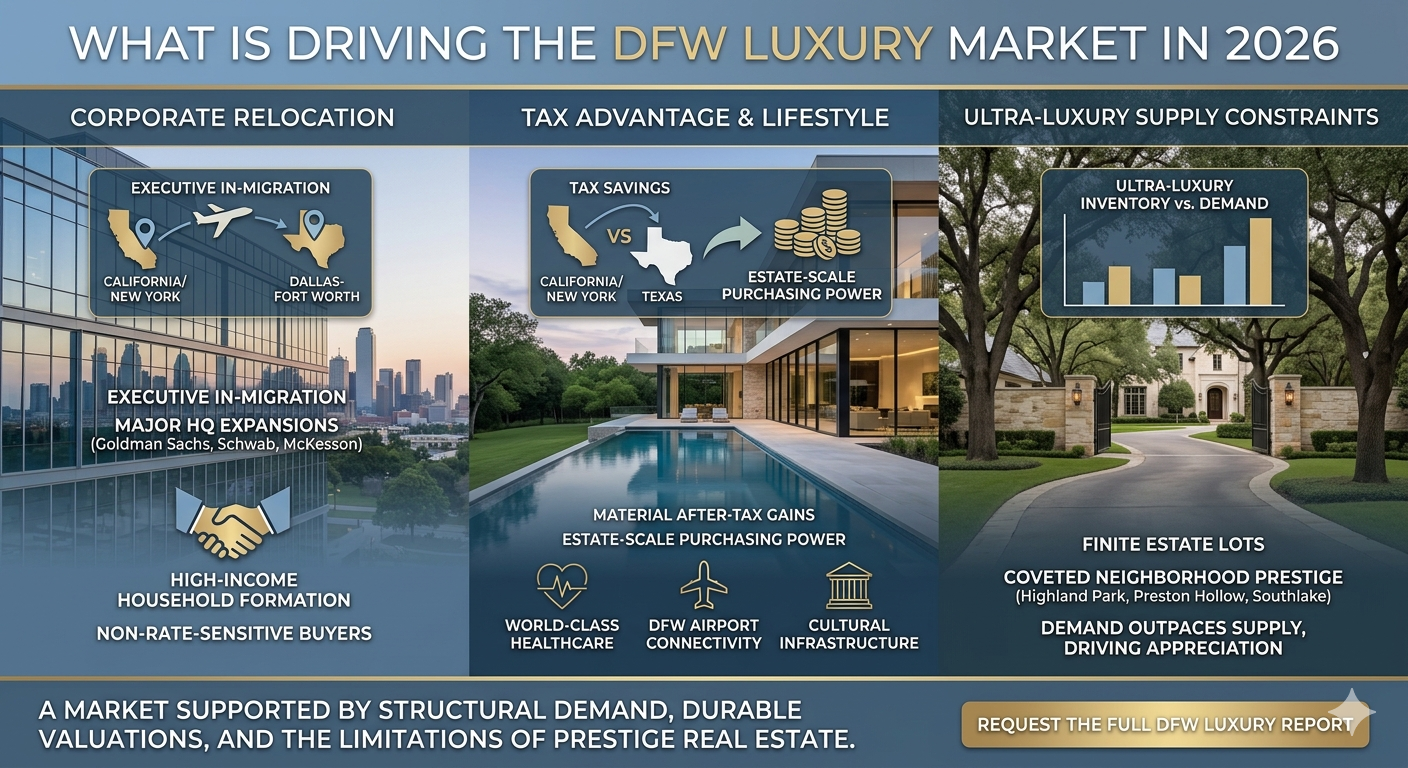
What Is Driving the DFW Luxury Market in 2026
The first question every buyer and seller asks me about the DFW luxury segment is the same: what is actually driving this market, and is it sustainable? It is the right question, because a market driven by temporary factors behaves very differently from one supported by structural demand, and the difference matters for every decision that follows.
Corporate Relocation and the Executive Housing Demand It Creates
Dallas-Fort Worth has been a corporate relocation destination for decades, but the pace and scale of that activity has accelerated in ways that are directly visible in luxury housing demand. When a company relocates its headquarters to DFW, it does not bring entry-level employees. It brings the executive and senior management tier whose housing choices land firmly in the luxury segment. Goldman Sachs, Charles Schwab, McKesson, CBRE, and dozens of other major firms have established or significantly expanded their North Texas footprint in recent years, and each of those expansions creates a wave of high-income household formation in the premium neighborhoods that define DFW luxury.
What makes this demand particularly durable is that corporate relocation buyers are not rate-sensitive in the way that first-time buyers are. A corporate relocation buyer who has sold a home in a higher-cost market, who is arriving with a relocation package, and who has a defined timeline does not wait for rates to fall before purchasing. They identify the neighborhood that fits their priorities, they engage a broker who knows that specific market, and they buy. That purchasing behavior supports DFW luxury even when broader market conditions are creating hesitation at lower price points.
High-Net-Worth In-Migration and the Tax Advantage That Fuels It
The second driver of DFW luxury demand is a buyer demographic that is not moving here for a job. It is moving here for a financial and lifestyle decision that makes Texas, and specifically DFW, one of the most compelling destinations for high-net-worth households in the country.
California, New York, and Illinois have collectively lost a significant number of high-income households to Texas over the past several years, and many of those households land in DFW rather than in Austin or San Antonio because DFW offers the cultural infrastructure, professional services, healthcare quality, and airport connectivity that high-net-worth buyers require alongside the tax environment that made Texas attractive in the first place. A household with $500,000 in annual income that moves from California to Texas is banking a material improvement in their after-tax financial position every year, and that calculation makes a premium Dallas or Collin County address look very different than it might have in a higher-tax environment.
This migration is not hypothetical. I see it directly in the buyer profiles I work with. The buyers who are arriving in DFW from coastal markets are sophisticated, they have done their research, and they are frequently prepared to pay for addresses that deliver on the community quality, school prestige, and lifestyle infrastructure they have decided to prioritize.
Why Supply Has Not Caught Up at the Top of the Market
DFW luxury inventory has grown at the entry level of the luxury segment, which runs from roughly $700,000 to $1.2 million across most DFW submarkets. That growth has provided more options for buyers in that range and has moderated the intensity of competition that existed during the peak years.
At the upper tier, specifically the genuinely exceptional properties in Preston Hollow, the Park Cities, Westlake, and the most established sections of Southlake, supply has not grown proportionally. The lots that support estate-scale construction in established inner-loop neighborhoods are finite. The neighborhood identities that make Preston Hollow and Highland Park what they are cannot be replicated in a new development on the fringe of the metro. The result is that demand for the most prestigious DFW addresses continues to outpace available supply in a way that supports values and in the most coveted sections, drives continued appreciation.
The DFW Luxury Neighborhoods That Deserve a Closer Look
DFW is a large and diverse metro, and luxury in this market is not concentrated in one place. Each of the premium neighborhoods I work in regularly offers a different version of the luxury buyer experience, and matching the neighborhood to the buyer matters as much as the price point.
Preston Hollow: Privacy, Scale, and Dallas's Most Coveted Estate Addresses
Preston Hollow is where Dallas luxury buyers who have the budget to choose anywhere tend to choose. The neighborhood's character is defined by significant lot sizes, mature tree canopy on established streets, and an estate culture that prizes privacy in a way that newer luxury communities built around shared amenities do not.
Preston Hollow's location within Dallas puts buyers within a reasonable distance of downtown Dallas professional life, Love Field for frequent flyers, and the Park Cities for the dining and retail that Dallas luxury buyers use regularly. The neighborhood has housed corporate executives, sports figures, political figures, and established Dallas families across generations, and that history of selective ownership is part of what makes a Preston Hollow address mean something beyond the square footage and the finishes.
The entry point for meaningful Preston Hollow inventory runs from approximately $1.5 million into the multiple millions for estate properties on premier streets. Buyers who approach this neighborhood with a clear set of priorities and a broker who knows the specific blocks will find a market that rewards preparation and punishes hesitation.
Highland Park and University Park: Walkable Prestige and the HPISD Premium
Highland Park and University Park, collectively known as the Park Cities, represent DFW's highest-density luxury market and the segment with the most consistent long-term appreciation track record in the metro. These are small, fully built-out municipalities entirely surrounded by the city of Dallas, which means their geographic exclusivity is structurally permanent rather than a function of current development patterns.
What drives the Park Cities premium above every other factor is Highland Park ISD. The district's academic performance, its institutional reputation across decades, and the community it creates around its schools makes a Park Cities address not simply a real estate purchase but an entry into a specific social and educational environment that a meaningful segment of DFW's professional class has decided is worth paying for. Buyers who are purchasing with school-age children and who have done their research on HPISD are not choosing the Park Cities. They are choosing HPISD and the Park Cities address comes with it.
The practical consequence is that Park Cities properties compete with unusual intensity even in markets where DFW luxury more broadly has softened. A well-priced University Park home in strong school feeder territory does not sit. It generates showings from prepared buyers who know exactly what they are buying and why.
Southlake and Westlake: Newer Construction at Luxury Scale With Carroll ISD
For luxury buyers who want the premium school district experience with newer construction and larger lot sizes than the Park Cities can offer, Southlake and Westlake in Tarrant County deliver a version of luxury living that attracts some of the most motivated buyers in the DFW metro.
Carroll ISD is one of a small number of Texas school districts whose academic and athletic reputation draws buyers specifically to its attendance zone the way HPISD does in the Park Cities. The combination of Carroll ISD, Southlake Town Square as a walkable retail and dining anchor, and the availability of custom and semi-custom luxury construction on lots that inner-loop Dallas neighborhoods cannot offer creates a buyer profile that is extremely consistent: families with school-age children, professional incomes above $400,000 annually, and a preference for new construction quality in a community setting.
Westlake is Southlake's smaller and more exclusive neighbor, home to Solana and Vaquero, two of the DFW metro's most prestigious private community addresses. Buyers at this level are not shopping Westlake because of school districts. They are purchasing a specific lifestyle proposition that includes privacy, security, and a community of peers that matches the level they have achieved professionally.
Prosper and Celina: The Emerging Luxury Frontier in Collin County
For buyers who are not anchored to an established neighborhood reputation and who want to maximize what their luxury budget delivers in terms of land and new construction quality, Prosper and Celina in Collin County represent the most compelling emerging luxury corridor in the DFW metro right now.
These are cities in active development, which means buyers are acquiring properties whose values will be influenced by what gets built around them over the next decade. That is a different risk and reward profile than purchasing in an established neighborhood with a century of history. For buyers with a ten-year-plus horizon who want significant acreage, genuinely custom construction, and the appreciation upside that comes from being positioned at the leading edge of a high-quality growth corridor, Prosper and Celina deserve consideration that they did not command five years ago.
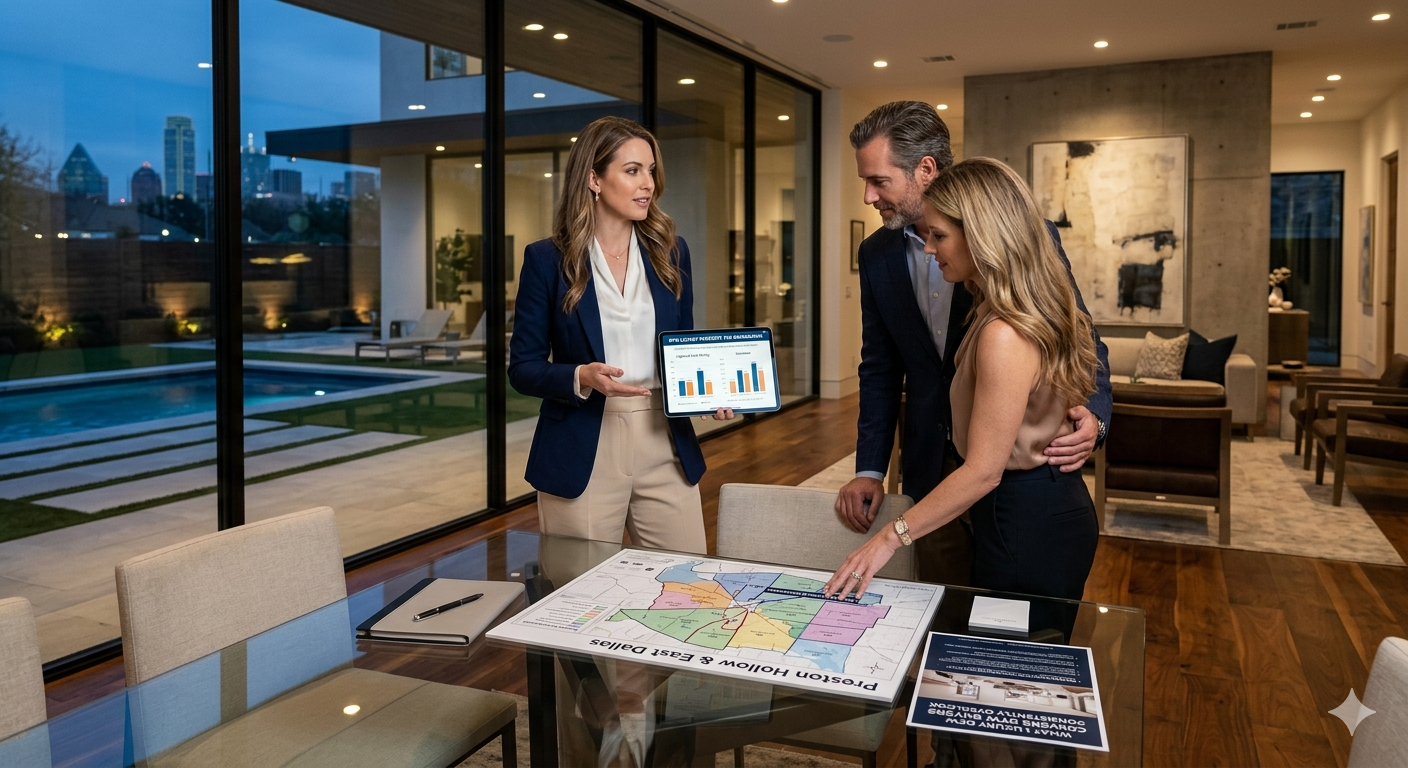
What Luxury DFW Buyers Consistently Overlook
The stakes at the luxury price point amplify every mistake, and the three patterns I see most consistently are the ones that cost buyers the most.
The Competition Is Real at Every Price Point
There is a pervasive assumption among buyers entering the luxury market for the first time that the upper price tiers move at a slower pace and that buyers have more time and flexibility than they would at entry level. This assumption is wrong in the DFW market, and it costs buyers properties they genuinely wanted.
I represented a buyer last year who was relocating from the Pacific Northwest with a budget in the $2.4 million range targeting Southlake. He was thorough, he asked excellent questions on every showing, and he was rightly cautious about a decision at this scale. A property came available on a street he had told me was exactly where he wanted to be. We scheduled a showing for the following morning. By the time we arrived, there was already a competing offer on the table submitted by a buyer who had seen it the previous afternoon. My client submitted that day, and we went into a multiple offer situation on a $2.4 million Southlake home. He ultimately won the property, but only because we were able to put together an offer the same day we saw it. If we had scheduled a second showing to think it through, we would have been too late.
The buyers competing for the same premium Southlake, Park Cities, and Preston Hollow properties as my clients are not unsophisticated. They are often corporate relocation buyers with professional support and clear timelines, buyers arriving from more expensive markets who view DFW prices as a relative discount, and investors with established advisory relationships who do not hesitate. The luxury buyer who assumes they can be leisurely will be outpaced consistently by the buyers who are prepared to act.
The Property Tax Reality on a Million-Dollar DFW Home
Texas's absence of a state income tax is one of the reasons high-net-worth buyers migrate here, and it is a genuinely meaningful financial advantage. What buyers, particularly those relocating from other states, frequently underweight is the property tax obligation that partially offsets that advantage at the luxury price point.
Effective property tax rates in Dallas County, Tarrant County, and Collin County commonly run between 1.8% and 2.6% of assessed value annually. In Highland Park specifically, the HPISD component of the total tax rate layers on top of the City of Highland Park and Dallas County obligations, producing a combined effective rate that buyers should calculate precisely before making an offer rather than estimating after the fact.
On a $2 million property at a 2.2% effective rate, the annual property tax obligation is $44,000, or approximately $3,667 per month added to housing cost beyond the mortgage. On a $3.5 million property at the same rate, the obligation exceeds $77,000 annually. These are not small numbers, and they deserve a place in the buyer's total cost of ownership calculation alongside the mortgage payment, insurance, and HOA fees that buyers more commonly account for.
I pull current data from the Dallas Central Appraisal District, the Tarrant Appraisal District, and the Collin Central Appraisal District for every property I work on at the luxury level. Buyers who have that number precisely before they are in contract make better decisions than buyers who discover it afterward.
School District Assignment Within the City Affects Resale
Buyers who are purchasing luxury properties in Dallas without school-age children sometimes underweight school district assignment because it does not affect their immediate daily life. It affects their resale, and in DFW luxury specifically, it affects it significantly.
In Preston Hollow and in parts of East Dallas, the specific school attendance zone assignment within Dallas ISD varies considerably in reputation and in the premium it commands in the resale market. A Preston Hollow address that feeds one of Dallas ISD's sought-after magnet programs or specialty schools has a materially different buyer pool when the time comes to sell than one that does not. Buyers who are purchasing for the long term, regardless of their current household composition, are purchasing resale potential alongside their primary residence. School zone verification before the offer is not a luxury amenity. It is standard due diligence that I make mandatory for every client.
Off-Market and Coming-Soon Inventory in DFW Luxury
One of the features of DFW luxury that buyers from outside the market often do not anticipate is how much of the most significant transaction activity occurs outside the publicly visible MLS listing process.
Why a Meaningful Share of DFW Luxury Never Hits the Active MLS
At the upper tier of the DFW luxury market, particularly above $2 million, a meaningful number of transactions are completed through broker-to-broker conversations, off-market showings, and coming-soon marketing that creates a buyer pool before a property is officially listed. Sellers at this level sometimes prefer a private process: estate situations, prominent individuals who do not want their address searchable during the marketing period, sellers of architecturally significant homes who want to control who sees them, and owners who want to gauge buyer interest before committing to a public listing.
The access required to participate in this segment of the market is entirely relational. No search tool provides access to a property that the seller has decided not to list publicly. Access requires being a broker who other brokers call when they have something worth calling about, which is built on years of being present, credible, and known at this level.
What It Takes to Access the Deals That Are Not Publicly Listed
I have shown properties in Preston Hollow, the Park Cities, and Southlake to buyers before those homes were ever publicly listed, because the listing broker trusted that I was bringing a serious, prepared buyer who would not waste the seller's time with a low offer or an unnecessary contingency. That trust is earned through years of operating at this level consistently enough that other luxury brokers in the DFW market know what to expect when I call.
The implication for buyers is direct: a serious DFW luxury buyer needs a broker with real relationships in this market, not a broker who learned the luxury segment recently or who primarily works at lower price points and occasionally takes a high-end listing. The relationship network that produces off-market access is specific to the segment and specific to the market, and it cannot be replicated by a newcomer or by a technology platform regardless of how sophisticated that platform is.

How Sharon's AI-Powered Approach Changes the Luxury Buyer's Experience
Technology and relationships are not competing priorities in luxury real estate. They complement each other, and the buyers I work with benefit from both.
Real-Time MLS Monitoring When Hours Matter at This Price Point
The conventional assumption is that technology matters most at the high-volume, entry-level end of the market. My experience in DFW luxury is the opposite. The cost of missing a relevant listing or of receiving information 48 hours after it is actionable is higher in absolute dollar terms at the luxury price point, which makes better information more valuable, not less.
As an AI-certified broker, I use tools that monitor the DFW MLS in real time and surface matching listings the moment they go active, not after the 24 to 72 hour syndication delay that consumer platforms introduce. For a buyer targeting Southlake or the Park Cities, where a well-priced property can receive serious interest within the first two days on market, seeing that property when it lists rather than days later is an operational advantage that directly affects outcomes. My buyers are never the ones who say they did not know that property was available.
More Accurate Pricing Intelligence for Properties That Are Harder to Comp
Luxury property pricing is inherently more complex than entry-level pricing because the properties are more unique and the number of genuinely comparable sales is smaller. A traditional comparative market analysis on a $3.5 million Preston Hollow estate may produce a range with meaningful variance depending on how the analyst adjusts for differences in lot size, renovation quality, pool features, guest house, and street character. Two experienced brokers looking at the same data can arrive at different price opinions, and the difference matters at this level.
My AI-assisted market analysis layers current active competing inventory, recent closed sales across adjacent luxury submarkets, price reduction velocity, days on market patterns by price tier, and current buyer search activity at the relevant price range to produce a pricing foundation that is more current and more granular than a conventional approach. Combined with 26 years of knowing which DFW luxury addresses hold value through multiple market cycles and which are priced on reputation rather than on fundamentals, that analysis is what I bring to every luxury client, buy-side and sell-side.
Your First Step in the DFW Luxury Market This Summer
The DFW luxury market is thriving for reasons that are structural, not cyclical, which means the conditions that are making this segment perform right now are not temporary. Corporate relocation demand, high-net-worth in-migration, and the permanent supply constraints at the most coveted DFW addresses are not going to reverse. What changes over time is the buyer's window to negotiate, to access the right properties at the right price, and to move with confidence in the specific submarkets that match their priorities.
If you are a serious luxury buyer in the DFW market and you want a direct conversation about what your budget accesses, which neighborhoods fit your specific situation, and what a well-positioned offer looks like at your price point, I want to have that conversation.
If you are a luxury seller in DFW trying to understand what the current market means for your pricing strategy and your marketing approach, that conversation is equally worth having before your listing goes live.
Call me directly at 832-388-9945 or schedule a luxury consultation at SharcomRealty.com. The DFW luxury market is not waiting, and the preparation conversation is where every successful transaction in this segment begins.