
Cash Offer vs. Traditional Sale in Fort Worth: Which Wins? | Sharcom Realty
Cash Offer vs. Traditional Sale in Fort Worth: Which Wins?
If you're preparing to sell your home in Fort Worth, you've likely already encountered the question: should you accept a cash offer or go the traditional route through a listed sale? It's one of the most consequential decisions a seller can make — and the right answer depends entirely on your priorities, timeline, and financial situation.
Fort Worth is one of the fastest-growing cities in Texas, consistently ranking among the top metros for population growth, job creation, and housing demand. That growth means sellers here often have real options. Cash buyers are active in the market, and a well-listed home can still attract multiple competing offers through the traditional process.
So which path actually wins? Let's break it down — honestly, and with the real numbers Fort Worth sellers need to know.

What Is a Cash Offer in Real Estate?
A cash offer means the buyer purchases your home without financing — no mortgage, no lender, no bank appraisal required. Cash buyers in Fort Worth include real estate investors, iBuyers (such as Opendoor or Offerpad), house-flipping companies, and individual buyers with liquid assets from a prior sale.
Because no lender is involved, the transaction moves faster and carries far fewer contingencies. That speed and simplicity is the core appeal.
What Is a Traditional Sale?
A traditional sale means listing your home on the MLS, marketing it to the full buyer pool, and working through the standard transaction process: inspections, appraisal, loan underwriting, and a 30–45 day closing timeline.
In a healthy Fort Worth market, a well-priced, well-presented home can attract multiple competing offers — including buyers using conventional, FHA, or VA financing.

Speed: Cash Wins, But by How Much?
This is where cash offers have their most undeniable advantage.
A cash sale in Fort Worth can close in as few as 7 to 14 days. Some investors and iBuyers can move even faster — occasionally in under a week if the paperwork is straightforward. For sellers facing foreclosure, divorce, relocation, estate situations, or any circumstance where time is the primary concern, this speed is genuinely valuable.
A traditional sale in Texas typically closes in 30 to 45 days from executed contract — and that's assuming the buyer's financing moves smoothly. Appraisal delays, underwriting issues, and buyer contingencies can push that timeline further. According to ICE Mortgage Technology, average mortgage closing times nationally hover around 43 days.
Verdict: Cash wins on speed — often by 3 to 5 weeks.

Sale Price: Traditional Sales Usually Net More
Here's the tradeoff most sellers don't fully account for when evaluating a cash offer: you almost always leave money on the table.
Cash buyers — particularly investors and iBuyers — factor in their profit margin, renovation costs, and carrying costs when making an offer. As a result, cash offers typically come in 10%–30% below fair market value. On a Fort Worth home worth $350,000, that discount could mean $35,000 to $105,000 less in your pocket.
According to the National Association of Realtors, homes sold through traditional MLS listings consistently achieve higher sale prices than off-market transactions — often significantly so in competitive markets like Fort Worth and the broader Tarrant County area.
A traditional sale, when executed with professional marketing and strong negotiation, gives you access to the full pool of buyers. More buyers means more competition, and more competition means better terms. In a market like Fort Worth — where demand remains elevated and inventory is still relatively tight in many neighborhoods — that competition can work heavily in your favor.
Verdict: Traditional sales typically net 10%–30% more. That gap is often the deciding factor.

Certainty and Risk: Where Cash Has the Edge
One of the quieter advantages of a cash offer is deal certainty. In a traditional sale, roughly 15%–20% of real estate contracts fall through before closing, according to Zillow research. The most common causes are financing failures, low appraisals, and inspection disputes.
With a cash buyer, financing risk disappears entirely. If the buyer is legitimate and has verified funds, the deal is highly likely to close. There's no lender to delay things, no appraisal that might come in below the agreed price, and typically fewer contingencies overall.
For sellers who've already purchased their next home or simply value certainty above all else, this reduced risk profile is meaningful.
Verdict: Cash offers carry significantly less deal risk. If certainty matters most, this tips the scale.
Costs and Fees: The Full Picture
Many sellers assume a cash sale saves money on fees. The reality is more nuanced.
In a traditional sale, you'll typically pay 5%–6% in agent commissions plus closing costs — but you're selling at or near full market value, which often more than offsets those fees.
With an iBuyer or investor, commissions may be lower, but iBuyers charge service fees of 5%–8% on top of an already discounted offer price. When you add both together, net proceeds are often significantly lower than a traditional sale.
Run the real numbers before deciding. The question isn't which option has lower fees — it's which puts more money in your pocket after everything.
Verdict: Traditional sales usually produce higher net proceeds, even after commissions.
When a Cash Offer Makes Sense in Fort Worth
A cash offer is worth serious consideration when:
Your timeline is urgent — relocation, foreclosure, divorce, estate settlement, or financial hardship where closing quickly is the priority
The home needs significant repairs — investors buy as-is; traditional buyers and lenders often require repairs before closing, especially with FHA or VA financing
You want simplicity over maximum profit — fewer showings, no staging, no open houses, and a predictable close date
The market is shifting — in a softening market, a guaranteed cash close can be more valuable than a higher but uncertain traditional offer
Fort Worth attracts active investors, especially in neighborhoods with rental demand and value-add potential. If you've received a cash offer, verify proof of funds and compare the net against what a traditional sale would realistically yield before committing.
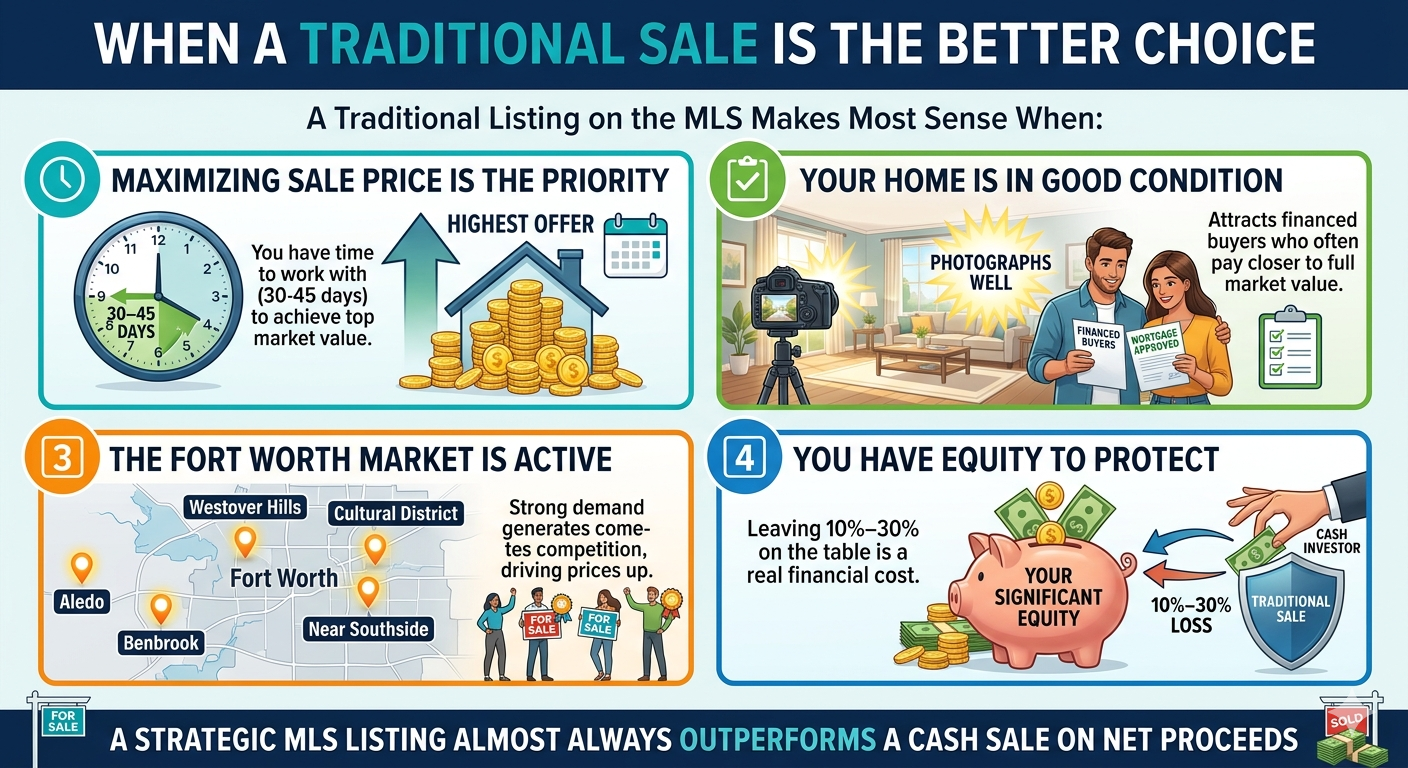
When a Traditional Sale Is the Better Choice
A traditional listing on the MLS makes the most sense when:
Maximizing sale price is the priority — and you have 30–45 days to work with
Your home is in good condition — well-maintained homes show well, photograph well, and attract financed buyers who often pay closer to full market value
The Fort Worth market in your neighborhood is active — strong demand means your listing will generate competition, which drives price up
You have equity to protect — if you've built significant equity, leaving 10%–30% on the table to a cash investor represents a real financial cost
Neighborhoods like Westover Hills, Aledo, Benbrook, and parts of the Near Southside and Cultural District consistently attract strong buyer competition on the open market — where a strategic listing almost always outperforms a cash sale on net proceeds.
Frequently Asked Questions: Cash Offer vs. Traditional Sale in Fort Worth
Is a cash offer always better for a seller in Fort Worth? Not necessarily. Cash offers are faster and carry less risk, but they typically come in well below market value. Whether a cash offer is "better" depends on your timeline, the condition of your home, and how much equity you're willing to trade for speed and certainty.
How much less is a typical cash offer compared to market value? Cash offers from investors and iBuyers commonly run 10%–30% below fair market value. On a $350,000 home, that could mean $35,000–$105,000 less than what you might net on the open market.
How long does a traditional home sale take in Fort Worth? Most traditional transactions in Fort Worth close in 30–45 days from executed contract, though market conditions, financing type, and inspection timelines can affect this.
Can I get a cash offer and still list on the MLS? Yes. You can use a cash offer as a baseline while simultaneously listing traditionally to see if the market produces a better outcome. A good agent can help you evaluate both paths simultaneously.
What neighborhoods in Fort Worth sell fastest on the open market? Neighborhoods with strong buyer demand in Fort Worth include Westover Hills, Aledo ISD communities, Benbrook, the Cultural District area, and parts of North Fort Worth and Keller. Proximity to top-rated school districts — particularly Keller ISD, Carroll ISD, and Fort Worth ISD — consistently drives buyer competition.
Should I work with a real estate agent even if I'm considering a cash offer? Yes. An experienced local agent can verify the legitimacy of cash offers, run a comparative market analysis so you know exactly what your home is worth, and help you decide whether accepting cash or listing traditionally is the smarter financial move.

About Sharon Yeary
Sharon Yeary is a licensed Texas Broker and founder of Sharcom Realty, serving sellers and buyers throughout Fort Worth, Houston, and the greater Texas market. Sharon specializes in pricing strategy, negotiation, and helping clients make confident decisions — whether they're evaluating a cash offer or preparing a full market listing.
Not Sure Which Path Is Right for You? Let's Talk.
Every Fort Worth home and every seller's situation is different. The right choice depends on your condition, timeline, equity, and goals — and those are conversations worth having with a trusted local expert before you decide.
Sharon Yeary — licensed Texas Broker, Sharcom Realty — will walk you through both options with honest numbers and zero pressure.
📞 Call or Text: 832-388-9945 🌐 Website: SharcomRealty.com 📧 Email: [email protected]